Supported cloud translation management systems (TMSs) have altered how brands localize their content. AI and automation emerge superfast with improved capabilities of translation speed and quality. These improvements have simplified the audience reach by generating accuracy, speed, and native content. Moreover, translation APIs improve the overall management of content and thus simplify the process of producing multilingual assets in bulk with ease to many businesses.
Applications of computer-assisted memories like English to Odia translation memory tools here provide cost savings to the companies in addition to reducing the workload of the translator. Instead of repeating translations and paying for the same pieces of text, known terms and segments of text are stored for automatic retrieval by translation memories. A highly additional aspect of this process is developing transliteration APIs that change foreign scripts to more recognizable forms and allow smooth interaction with several languages.
This paper investigates the degree of redundancy that could, theoretically, be reduced by translation memory and improved output. It discusses translation memory, what it is and how it works, and most importantly, why organizations should consider it a priority in their translation management solutions.
Also Read- Essential Steps to Successful Multilingual Support
What is Translation Memory?
Translation memory is defined as linguistic databases that store sentences, paragraphs, or phrase segments translated into a specific target language and source language. When a similar text occurs in a new translation, the automated translation process allows the system to suggest these pre-translated elements to the translator. A machine translation API can set the first pass of translation, and translation memory will polish this output to ensure consistency across projects.
This database, depending on the variables set, can throw up the right language and context to suggest. The leading translation tools allow for the perfect match (or exact match) or fuzzy match that widens the scope.
In the end, translation memory guarantees consistency in terms of language use, allows translations to happen faster, and reduces workload through the elimination of unnecessary translations. This improves productivity and ensures quality translation across multiple projects and languages.
Using Translation Memory
A translation memory does away with the repetitive facets of human translation. Strong string searching and indexing let a translator focus on new content rather than phrases that show up too frequently. For instance, OCR online translation services can convert text from images to editable formats for subsequent translation by translation memory.
Also Read – Key Things to Consider while Localizing your Long-form content
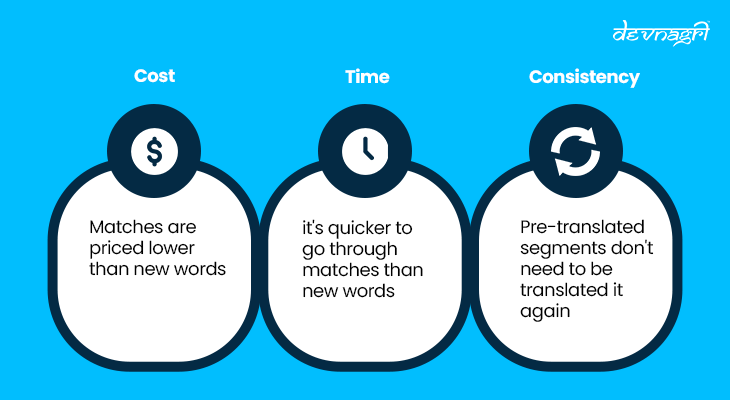
The TMS and translation memory come hand in hand with a lot of benefits, including:
Consistency:
The human translator makes mistakes or interprets phrases differently depending upon the context, leading to inconsistencies in massive projects. A translation memory ensures that any single example of a word or phrase within the content remains consistent throughout the translation process.
Cost Savings:
Where translation memory is good, the source language translation is always the one taking more time. Hence, more and more upholders of costs are repeated translations of exact matches. Translation memories use strings without further cost items. The more strings are excluded from the scope for translation, the lesser the translation cost.
Better Quality:
Given the availability of computerized tools and technology, both program and linguists may fine-tune the translation memory entries while making them more brand-consistent and brand-compliant. Thus, the translation will be technically correct and abide by the client’s brand guidelines. Thus, this becomes a premium for future translations, as well.
Centralized Database:
With translation memory built into a TMS, every user and department across the organization has access to it in a centralized database. This thus will guarantee a consistent application of brand and tone, across projects with various stakeholders and translators.
Faster Time to Market:
Lesser redundancy in translations speeds the process and saves translator time. The same reduction is true for editing and post-production time. The overall productivity of the TMS allows the translation team to submit translations ready for market entry sooner.
Higher Revenues:
According to some recent reports, 40% of users are unwilling to buy from a website in another language even while 66% make some use of online machine translation. Thus, software with native-level capabilities would capture more buyers.
Window for Expansion Globally:
Machine translation APIs now boast over 190 thousand language pairs to guarantee content translation across any set of languages. With each technological advancement, organizations can expand their reach to more markets and build a global enterprise.
Also Read- 5 Step Plan for Global Market Entry Using AI Powered Machine Translation
Translation Memory in Devnagri AI
With an advanced TMS, Devnagri AI allows seamless operation not only for machine translation but also for human translation and both process optimizations for any language like English to Odia Translation. It has translation memory features that fasten the production process so that translators can concentrate on new content requiring consistent results.
While these functionalities are already found in the basic translation memory, Devnagri AI carries the premise further with these unique features:
- Multiple translation memory databases can be supported.
- Translation memory can be used for all content types, anywhere.
- Customizable string entries with functions to move, delete, and edit.
- Search in TM by keywords, authors, languages, translators, etc.
- Import established translation memory.
- Export and download part or all of TM data.
This allows for faster translation and a more refined workflow compared to simple translation applications. Apart from these, OCR translation online also enables these further by establishing the ease of accessing images for translating text.
The traditional translation memory management system offers no control over traditional translation memory administration.
Translation memory is thus being controlled and dictated by Devnagri AI with all data visible and accessible within the Devnagri AI platform. Users can perform terminology management functions such as modifying existing translation memory entries, refining entries for tone or context, and removing data whenever needed. This gives the brands sovereignty over their translation memory database through easy access within the platform.
- The traditional method of editing translation memories involved manual processes that were prone to error:
- A user exports translation memory into an Excel spreadsheet.
- The editor makes necessary changes in the spreadsheet.
- After editing, the user uploads and re-imports the database into the TMS.
The manual steps could introduce errors into the translation memory or a corrupted file. In the case of Devnagri AI, the user can easily update, edit, or delete an entry in the TMS without impairing or corrupting any other entries.
Users also move content between existing translation memories, export memories, and work with the platform’s search function to find entries by language, author, dates, or other parameters.
Translation memory and machine translation are two important components of a translation platform. However, they are two entirely different concepts, each serving a different purpose in a translation project: Modern machine translation APIs interpret a source text and produce the translated document by using neural networks. This is a fast way to check some major points of the source document or facilitate understanding. Yet machine translation is not always contextually accurate or culturally appropriate.
On the contrary, translation memory stores phrases and sentences translated by actual human translators-they are trying to recognize similar phrases and pull up the assigned translation from the language pairs defined in their translation memory database. It helps in maintaining consistency and accuracy in translations, while also allowing human intervention and adjustment.
Thus, by executing cloud translation within TMS, users achieve fast, efficient, valid, and reliable translations. Machine translation APIs provide a great testing ground for the translator to work on, while translation memory builds consistency when it comes to the most metro and common phrases and words scattered across different assets.
Also Read- Creating Content Only in English? Here’s What You’re Missing Out
A Translation Memory, Lifestyle Glossaries, and Stylebooks
Like a glossary or style guide, a translation memory helps professional translators maintain consistency in brand voice, tone, and style. But translation memories are more complicated than style guides, which outline the rules governing multilingual terms and the most basic usage. Instead, translation memory houses source content and corresponding translated content.
When Should You Use Translation Memory?
Translation memory works best during translation projects of massive proportions that take place regularly and when uniformity in terms and phrases is hard to maintain. Potential areas for application are as follows:
Translation memory allows for consistency and speeds up the translation of frequently repeated phrases, jargon, or industry-specific terminology.
Translation memory allows several translators to work on the same project at a time and maintain consistency between individual assets.
Translation memory helps keep consistency for translation of updating files by allowing the reuse of previously translated materials, thereby reducing effort while obtaining the highest cost-benefit.
Devnagri AI machine translation combined with Translation Memory for maximum efficiency.
Devnagri AI provides agencies with AI-ready tools and translation facilities that help to recreate each valuable asset in multiple languages promptly and at less expense. Online English to Odia translation could convert documents into formats easy to translate, thereby extracting speed.
Machine translation APIs encourage short translation times while maintaining accuracy. The platform’s translation memory tools allow companies to fine-tune machine translation to keep the brand style, tone, and context throughout the entire translation process. This, in turn, allows relatively cheaper creation of personalized, native content for every target language.