
The Reserve Bank of India has spent the last two years tightening its stance on transparency in lending. Its April 2024 notification on Key Fact Statements marked a clear shift: pricing and terms are no longer enough, borrowers must receive that information in a language they can actually read.
For banks, NBFCs, and fintechs running digital lending at scale, KFS language compliance has moved from good practice to a defined regulatory expectation, with a direct line into every onboarding workflow, loan agreement, and audit trail. This guide breaks down what the RBI KFS guidelines require, where lenders typically get language compliance wrong, and how a language AI platform closes the gap between regulatory intent and day-to-day banking document translation.
Understanding RBI KFS Guidelines for Language Compliance
What Is a Key Fact Statement?
A key fact statement is a standardised, one-page summary of a loan's essential terms: the annual percentage rate, all applicable fees, the repayment schedule, and any recovery or default clauses. RBI introduced the current format through its April 15, 2024 notification, which superseded earlier fair practice guidance and became binding for retail and MSME term loans sanctioned on or after October 1, 2024.
RBI excludes credit card receivables, but nearly every other consumer and small-business lending product falls under scope. The document exists to give borrowers one place to check the true cost of a loan before they sign, rather than piecing it together from a lengthy agreement.
Language Requirements Under RBI Guidelines
The notification is direct: lenders must present the KFS in a language understood by the borrower. RBI has not published a prescriptive list of accepted languages or a formula for determining which one applies, so lenders carry the responsibility of identifying a borrower's preferred language and producing compliant documentation in it.
In digital lending journeys, this obligation extends beyond the KFS document itself. Buttons, disclosures, and consent screens in the borrower's chosen language now count as part of what a compliant interface looks like, not as an optional accessibility feature.
Scope of Compliance for Lenders
Banks, cooperative banks, small finance banks, NBFCs, housing finance companies, and microfinance institutions all fall within scope. Lenders must obtain a borrower acknowledgement confirming the borrower understood the KFS before finalising the loan agreement, and the KFS carries a validity period.
Three working days for loans with a tenor of seven days or more, and one working day for shorter-tenor loans. Font size, layout, and structure also follow RBI specifications, which means language compliance cannot run as a one-off translation task. It has to sit inside a repeatable, auditable process.
Common Challenges in KFS Language Compliance
Loan language is a legal issue, and a mistranslated phrase on prepayment penalties or default triggers might expose a lender to litigation or regulatory investigation. Generic translation tools handle general text well but were not built for financial and legal precision, and a literal rendering of a clause can shift its meaning enough to create real risk. Lenders need a translation that understands loan structuring, not just vocabulary.
Consistency Across Lending Workflows
A KFS is rarely a standalone document. It has to align with the loan agreement, the sanction letter, and any subsequent amendment notices, all of which may also require vernacular versions. When translation happens manually or across disconnected vendors, small inconsistencies creep in between documents, and that becomes a real problem the moment an auditor or a court compares them side by side.
Managing Multiple Indian Languages
India's linguistic diversity means the same branch, or the same digital onboarding flow, may need to serve borrowers in four or five languages within a single city. Building and maintaining accurate KFS templates across a dozen or more Indian languages, then keeping every version updated whenever RBI issues a new circular, is a workload most compliance and legal teams lack the bandwidth to carry manually.
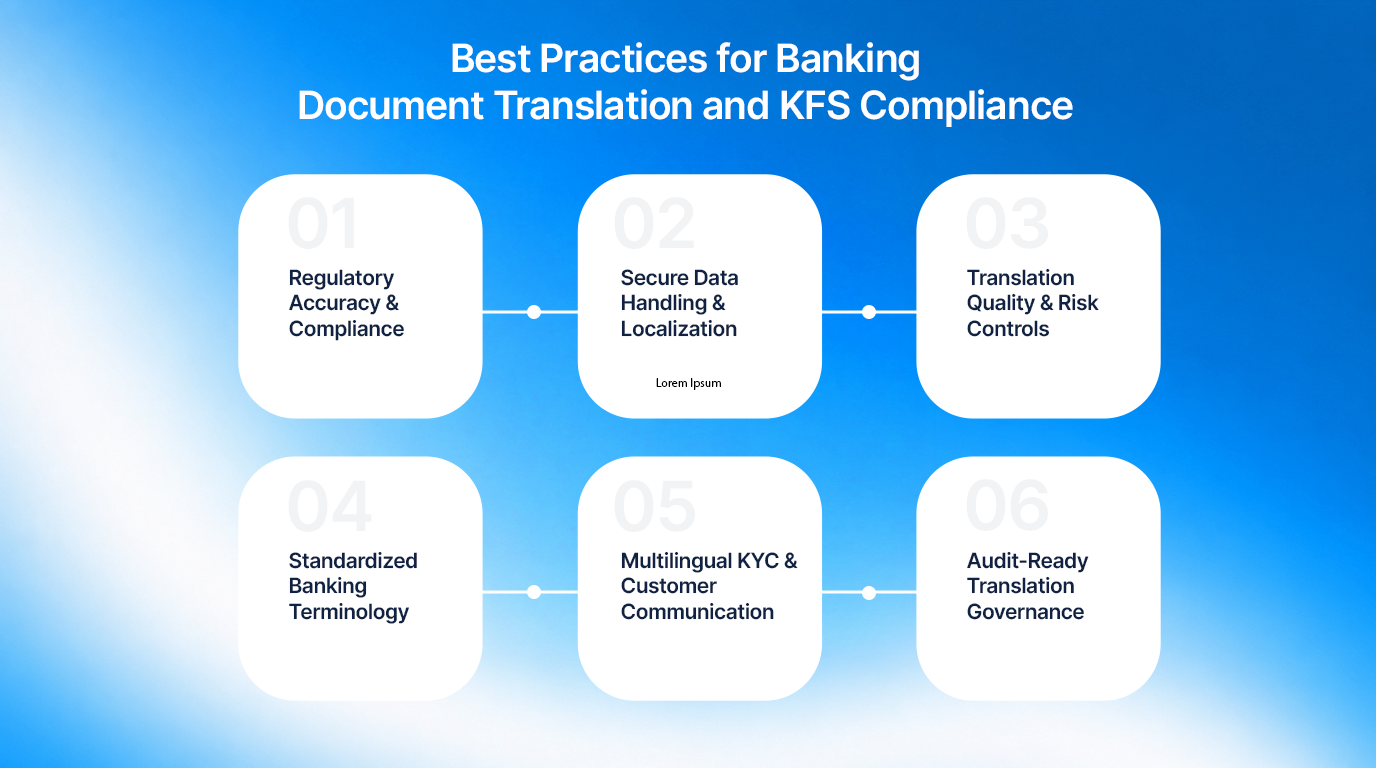
Best Practices for Banking Document Translation and KFS Compliance
Lenders should capture a borrower's preferred language at the earliest possible point in the onboarding journey, whether that is a branch form, an app selection screen, or an IVR prompt, and store that preference against the borrower's profile so every subsequent document generation step can reference it automatically.
Standardising KFS Documents
Building a single, RBI-compliant KFS template per loan product, then generating each language version from that template, reduces the drift that happens when teams translate documents independently over time. A centralised repository covering every product and every supported language gives compliance teams a single place to manage updates, rather than chasing versions across departments.
Automating Translation Workflows
Manual translation does not scale against RBI's timelines. Loan sanctioning, KFS delivery, and borrower acknowledgement often need to happen within the same digital session, which leaves no room for a document to sit in a translation queue for days. Automated workflows that generate a compliant KFS in the borrower's language at the moment of sanction keep the process inside regulatory turnaround expectations.
Maintaining Audit Readiness
Every KFS issued by a lender, in every language, must remain retrievable with a record of when it was generated, delivered, and acknowledged. RBI examiners look for this trail during inspections, and a lender that cannot produce a specific vernacular KFS on request has a compliance gap regardless of how accurate the original translation was.
Using a Language AI Platform for Language Document Translation
A language AI platform built for financial services does not just convert text between languages. It applies domain-specific models trained on banking and regulatory content, so terms like moratorium, foreclosure, and annual percentage rate carry the same legal meaning across every version of the document.
Enterprise Integrations
For KFS delivery to occur during the loan sanctioning moment, translation must be integrated into the core banking, loan origination, or CRM system that generates the document, rather than being a separate manual step afterward. Devnagri connects into these existing systems, so the same workflow that creates the English version also produces a compliant, borrower-language KFS, rather than treating translation as an afterthought.
Governance and Quality Control
Because KFS content carries regulatory and legal consequences, translation output needs review layers, version control, and a clear audit trail showing what the system generated, when, and against which template. Devnagri builds these controls into the workflow itself, so every language version stays traceable back to its source document and its approval history.
Compliance at Scale
A lender operating across a dozen states does not need a dozen separate translation processes. A governed language infrastructure layer lets one compliance framework produce accurate, audit-ready KFS documents across every Indian language a lender's borrower base actually speaks, without adding headcount for every new region or product launch.
Indian Language AI and the Future of Language Lending
Beyond Document Translation
KFS compliance is one checkpoint inside a much longer borrower journey that includes onboarding, servicing, collections, and grievance redressal, all of which carry their language expectations under RBI and sector-specific regulators. Lenders that build language infrastructure only for the KFS will likely rebuild the same capability again for the next regulatory requirement.
End-to-End Language Workflows
Extending language capability across the full lending lifecycle, KYC, onboarding, servicing calls, and grievance handling, means a borrower interacts with a lender in one consistent language rather than switching between English disclosures and vernacular support. That consistency is also where measurable gains in onboarding completion and borrower trust tend to show up.
RBI has moved incrementally toward vernacular requirements since its 2015 Fair Practices Code, and the KFS notification is the clearest expression of that direction so far. Lenders that treat language as infrastructure now, rather than a compliance patch applied after each new circular, will be better positioned for whatever the next disclosure requirement turns out to be.
Conclusion
KFS language compliance is no longer a documentation detail lenders can defer. RBI has made borrower-language delivery a defined requirement, and the operational burden of producing accurate, auditable banking document translation across every Indian language a lender serves only grows as digital lending scales.
Treating language as infrastructure, rather than as a manual step bolted onto each new circular, is what makes compliance sustainable. Devnagri's language AI platform gives lending teams that infrastructure, connecting Indian language AI directly into existing lending workflows so every KFS reaches the borrower correctly, on time, and on record.