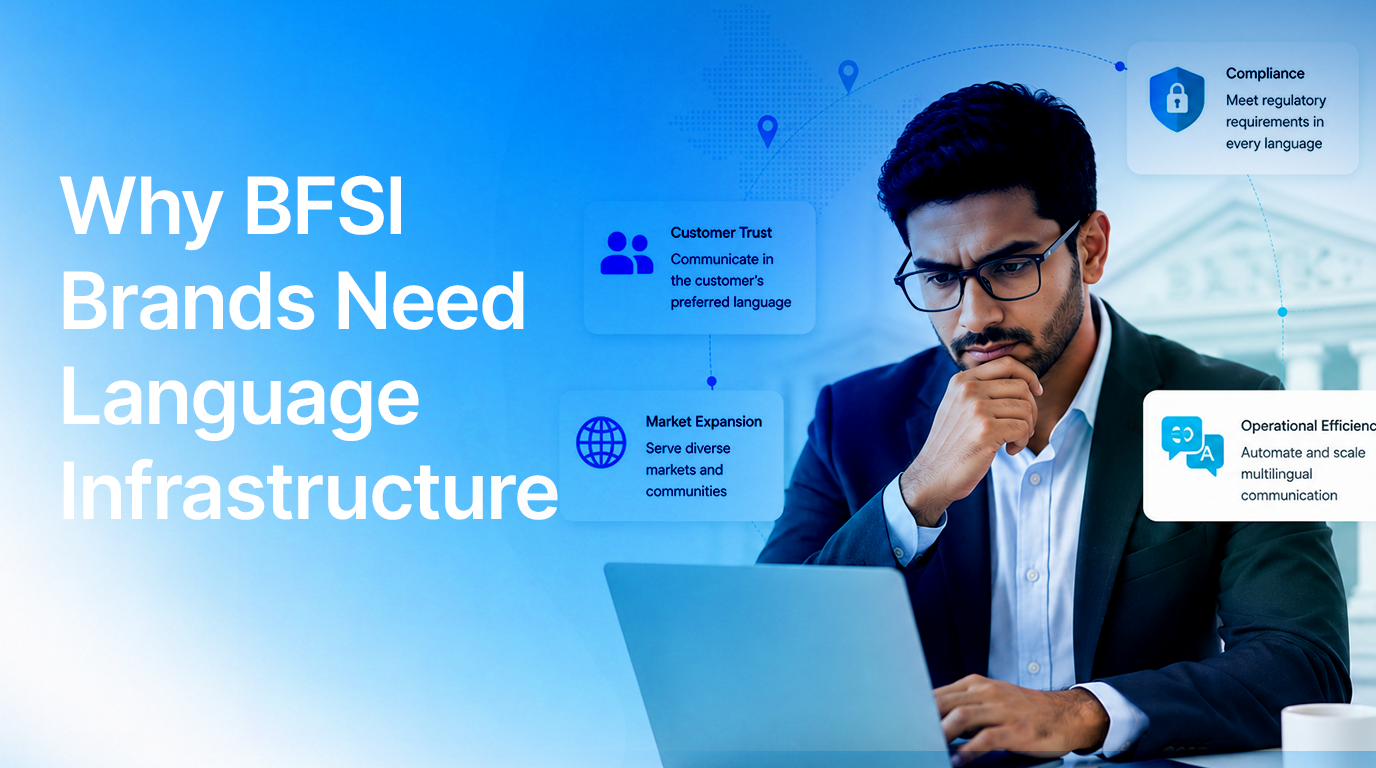
Most BFSI institutions lose customers not because their products are wrong, but because their language layer is broken. A KYC form in English, a collections call in Hindi, and a grievance response with no regional-language option – each of these gaps chips away at trust. Language infrastructure fixes these issues at the system level, and the Multilingual Reach Estimator shows you exactly where your gap sits today.
What Is Language Infrastructure in BFSI?
Language infrastructure is not a translation plugin bolted onto an existing workflow. It's a governed layer that sits between your core banking systems, CRM, contact centre, and mobile app on one side and your customers' preferred language on the other, handling every interaction consistently and providing full audit visibility.
In practice, this means onboarding forms, KYC documents, collections calls, and grievance responses are all generated, delivered, and logged in the borrower's language, without a human translator re-keying content at every step. The system governs tone, terminology, and compliance language centrally, so a loan disclosure in Tamil says exactly what the English version says, no drift, no manual reconciliation.
This is the distinction that matters: translation converts text. Language infrastructure governs a workflow. One is a task. The other is a system of record.
Why BFSI Brands Are Prioritising Language Infrastructure in 2026?
Three forces are converging, and none of them are slowing down.
Regulatory pressure is language-specific now
RBI's KFS (Key Fact Statement) disclosure norms and evolving vernacular communication expectations mean regulators increasingly expect borrowers to receive disclosures they can actually read, not just a compliant English document. That shifts language from a UX nice-to-have to a compliance requirement.
Borrower expectations have moved past Metropolitan cities
Tier 2 and Tier 3 markets, where much of BFSI's growth is coming from, are not primarily English-first. A borrower who can't read the loan terms in their language is a borrower who either drops off or signs without understanding what they agreed to. Both outcomes carry risk: one shows up as lost conversion, the other as a grievance or default down the line.
Manual translation doesn't scale with product velocity
Every new loan product, every policy update, and every regulatory circular currently gets routed through a translation queue that is inconsistent, slow, and impossible to audit at scale. As BFSI institutions launch more regional-language variants of their core products, the manual model breaks down first.
Put together, institutions that treat language as infrastructure, are governed, are audited, and are embedded in the workflow are the ones scaling into regional markets without scaling risk alongside them.
What Is the Multilingual Reach Estimator?
The Multilingual Reach Estimator is a free diagnostic tool built by Devnagri AI to show BFSI teams where their current language coverage falls short of their addressable market.
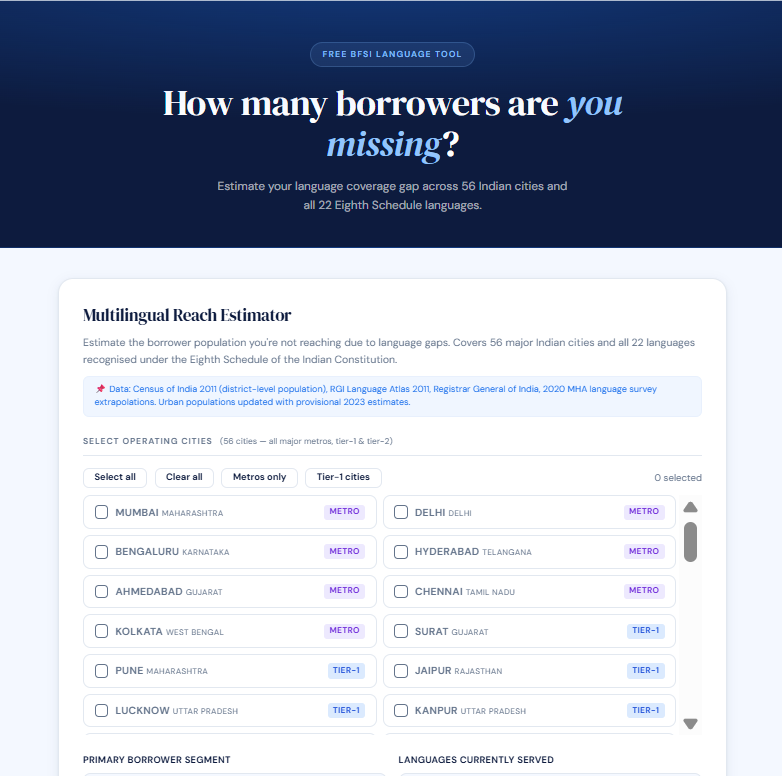
You input a few details about your current customer base, target geographies, and existing language support across onboarding, KYC, and servicing. The tool maps that against regional language demand data and returns a clear picture: the percentage of your addressable borrower base you're likely undeserving because of language gaps, and where in the customer journey that gap does the most damage.
It's built to answer one question directly: not "Should we invest in language infrastructure?" but "How much of our own growth are we currently missing out on?"
How to Check Your Own Language Gap
- List your active markets and target geographies: Note which states or regions you're currently serving versus where you're planning to expand.
- Map your current language coverage by workflow: Check onboarding, KYC, loan disclosures, collections, and grievance handling separately, as coverage is rarely uniform across all five.
- Run your details through the Multilingual Reach Estimator: It benchmarks your inputs against regional language demand in your target markets.
- Review the gap by workflow stage, not just overall: A gap concentrated in KYC drop-off means something different than a gap concentrated in collections response rates; the fix and the urgency differ.
- Prioritise the highest-friction workflow first: Most institutions find one or two workflows, usually onboarding or collections, account for the majority of the reach gap. Start there rather than trying to localise everything at once.
Language as Infrastructure vs. Language as an Afterthought
Without a governed language layer, BFSI teams typically manage multilingual communication through a patchwork: a translation vendor for disclosures, a regional-language agent desk for calls, and ad hoc localisation for the app or website whenever someone raises it. Each piece is managed separately, none of it is audited centrally, and inconsistency between channels is common; a borrower might get an English SMS after a Hindi call or a KFS document that doesn't match what the agent explained verbally.
With language treated as infrastructure, all of this runs through a single governed layer. Terminology stays consistent across SMS, app, call, and document. Every interaction is logged and auditable, which matters when a regulator or an internal compliance team asks for evidence of what a borrower was actually told. And rolling out a new regional language becomes a configuration exercise, not a multi-month vendor engagement.
The difference shows up in outcomes, not just process. Institutions with governed language infrastructure typically see meaningfully better onboarding completion and collections response rates in regional-language segments, simply because the friction of not being understood is removed from the workflow.
Conclusion
Language infrastructure isn't a translation upgrade; it's a decision about whether your BFSI institution treats regional-language borrowers as a core part of the business or as an edge case to be patched around. The Multilingual Reach Estimator gives you a concrete starting point: a number that shows how much of your addressable market your current setup is missing and where to fix it first.