When you think about business growth, language is not on the list. People think it does not matter at all what it has to do with a language. Leaders usually start with strategy, product, or marketing. But here’s the truth, the way you communicate in new markets often decides whether customers trust you or turn away.
We have seen companies with brilliant offerings lose traction simply because the website or mobile app looked foreign. On the other hand, businesses that invested early in the correct type of translation moved faster, built stronger connections, and even cut compliance risks.
So, if you are wondering which type of translation fits your business, let us break it down in plain terms.
Why Is Translation Not Optional Anymore?
A few numbers tell the story. CSA Research reported that 76 percent of buyers prefer to purchase when content is available in their native language, and 40 percent refuse to buy at all if it is not.
That is huge. Imagine spending millions on advertising only to lose almost half your prospects because your product page is stuck in English.
Translation today is not a fancy expense. It is a way to invest in growth, following the rules, and building trust with customers. And the kind of translation you choose is more important than most people think.
APIs for Website Localization and Translation
Your website is the front face of your business when a customer sees it. It can feel frigid if it’s solely in English or, even worse, poorly translated. Website localization is more than just text; it involves adapting tone, visuals, currency, and even date formats.
One company rolled out an English to Odia translation for their eCommerce site. They used a translation API to automate product pages. The result? Faster updates, fewer errors, and sales went up in the Odisha region within weeks.
The data backs it. Localized websites have shown 1.5x higher conversions compared to English-only versions (CSA Research). That is not theory, that is business impact.
Mobile App Translation
Now think about mobile apps. India is already a mobile-first market. Statista says the country will have 659 million smartphone users by 2025 (Statista). That is an ocean of customers. But if your app only runs in English, you are ignoring millions.
App translation is not just about menus. Notifications, payment flows, customer support FAQs, and more all need adaptation. We have seen fintech apps lose users simply because payment confirmation messages were confusing in English. Translate that into Odia or Hindi, and suddenly the drop-off rates shrink.
The difference between adoption and abandonment often comes down to clarity in the customer’s own language.
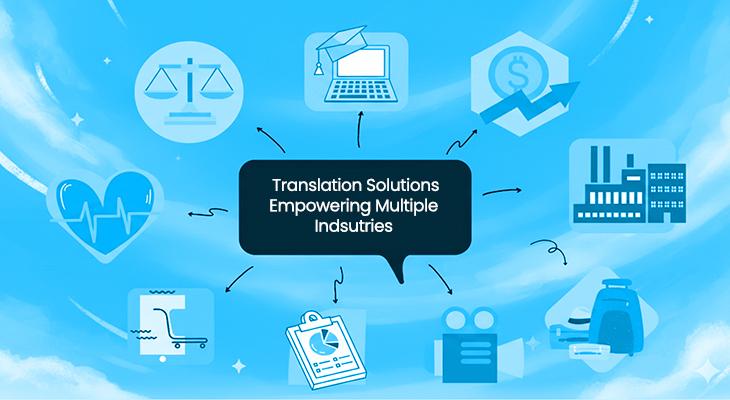
Legal and Finance: Where Accuracy Is Non-Negotiable
Some sectors have zero margin for error. At the top are law and finance.
If a financial form or compliance document is translated poorly, it could lead to lawsuits, fines, or problems with the law. That’s why firms need professionals to translate financial and legal documents.
One customer of a bank learnt this the hard way. They attempted to use a standard translation for loan agreements. The meaning of many clauses changes during the translation. It took months to correct, and customers lost trust in the company.
Deloitte has pointed out that financial institutions entering multilingual markets spend around 20 percent more on compliance-focused translation than other industries (Deloitte Insights). That cost is small compared to the risk of mistranslation.
Media, Publishing, and the Power of Subtitles
Media moves fast. Publishers and broadcasters cannot afford to delay releases for weeks just to get translations right.
That is why media translation and media publishing translation solutions matter. Whether it is an eBook, a news story, or a streaming show, speed and context are everything.
Take subtitles. Netflix shared that over 80 percent of US subscribers watch non-English shows with subtitles (Netflix Tech Blog). That tells you subtitles are not an accessory. They are a growth driver.
And voice-over translation? It’s been a game-changer for regional OTT platforms in India. A Telugu show dubbed in Odia or Hindi suddenly attracts a lot more viewers, doubling the number of subscribers.
eBooks and eLearning Translation
Knowledge travels differently today. Authors, educators, and corporations are realizing that one language is not enough.
eBook translation helps authors reach new readers. But the bigger story is eLearning translation solutions. Employees worldwide require corporate, compliance, and onboarding training.
Docebo said that 67 percent of businesses throughout the world think that multilingual eLearning is essential for developing talent (Docebo Report). That is two-thirds of the market. Without translation, you risk employees falling behind due to language barriers.
Document Translation: The Quiet Workhorse
Not all translating is fun. Consider items such as safety instructions, HR regulations, or technical guides. These are papers that workers and customers use every day.
Translation of documents ensures they are clear and correct. No flashy ads, just good communication. A misstep in a technical manual or product safety sheet can cost lives, not just money.
Manufacturing companies reduce errors on factory floors after rolling out localized safety manuals. Sometimes the impact is that direct.
The Cultural Angle Most Businesses Miss
Now, here is something decision makers often forget, translation is also about cultural nuance.
Languages like Odia or Hindi use respect markers that English does not. If your customer support chatbot ignores this, the conversation may sound rude. That is not a software bug, but it feels like one to the user.
Colors, imagery, and even number formatting play roles. In the US, people use commas a lot (100,000). In India, though, people are habituated to the lakh and crore formats (1,00,000).
Real-World Business Impact
- Retail: Sales in the region increased by 18% over three months in the areas of Odisha and Vishakhapatnam. When a clothing brand incorporated Odia translations for checkout procedures.
- Banking: A bank that offered account-opening forms in more than one language cut mistakes by 25%.
- Education: A learning platform that offered compliance training in seven different Indian languages. 40% more participants finished the course.
- A regional OTT app doubled its membership after investing in voice-overs and subtitles.
These are not side benefits. They are core business results.
The ROI Question
So, is it worth the money?
The data suggests yes. According to CSA Research, businesses that offer localized experiences are 1.5 to 2 times more likely to increase revenue in new areas. You get a return on your investment by increasing sales, reducing the risk of non-compliance, and fostering deeper relationships with customers.
In short, translation pays for itself.
Looking Ahead
The trend is clear. Businesses are no longer perceiving translation as something that needs to be done outside of work. When translation APIs are connected to content management systems, updates are instantly available in a lot of languages.
A SaaS provider can develop a new feature page in English today, and by tomorrow, it will be easy to read in Odia, Hindi, or Spanish. That is the future: localization that never ends.
AI will continue to improve, but it will always need to be monitored. Sectors that have to follow a lot of rules can’t afford to make mistakes. The best approach will be to utilize both technology and people.
Closing Thoughts
If you are leading expansion into new regions, the right question is not “Do we need translation?” but “Which type of translation protects our brand and fuels growth?”
A fintech cannot ignore legal precision. A media firm cannot skip subtitles. An eLearning platform cannot train staff in only one language.
Translation, when treated as a strategy, becomes a growth engine. Treated as an afterthought, it becomes a liability. The choice rests with leadership.
FAQs
Q:1 What is the translation method in finance?
A:1 In finance, translation is all about precision. A single word can change the meaning of a contract, so the process usually starts with building a financial glossary, then using AI tools to handle scale, and finally letting experts review the output to make sure every clause is accurate and regulator-approved.
Q:2 What is the translation type?
A:2 It refers to the category of service used. For example, document translation, subtitle translation, or website localization.
Q:3 What is the best type of translation?
A:3 AI-Powered Machine Translation is the best type of translation suitable for businesses.
Q:4 Which translation service is right for my business?
A:4 It depends on your goals. Digital-first brands benefit from localization and app translation. Finance and legal firms need compliance-focused solutions. Media players depend on voice-over and subtitle translation.