The word "chatbot" now covers an unusually wide range of technology, from a scripted FAQ widget in a website footer to a large language model managing complex, multi-turn service conversations with full context retention. For enterprise decision-makers evaluating conversational AI, that ambiguity carries real strategic risk.
The distinction between a traditional and a generative AI chatbot is not primarily a matter of sophistication. It is a matter of architecture, and architecture determines what a system can actually do under real operating conditions and what it fundamentally cannot.
What Is a Traditional AI Chatbot?
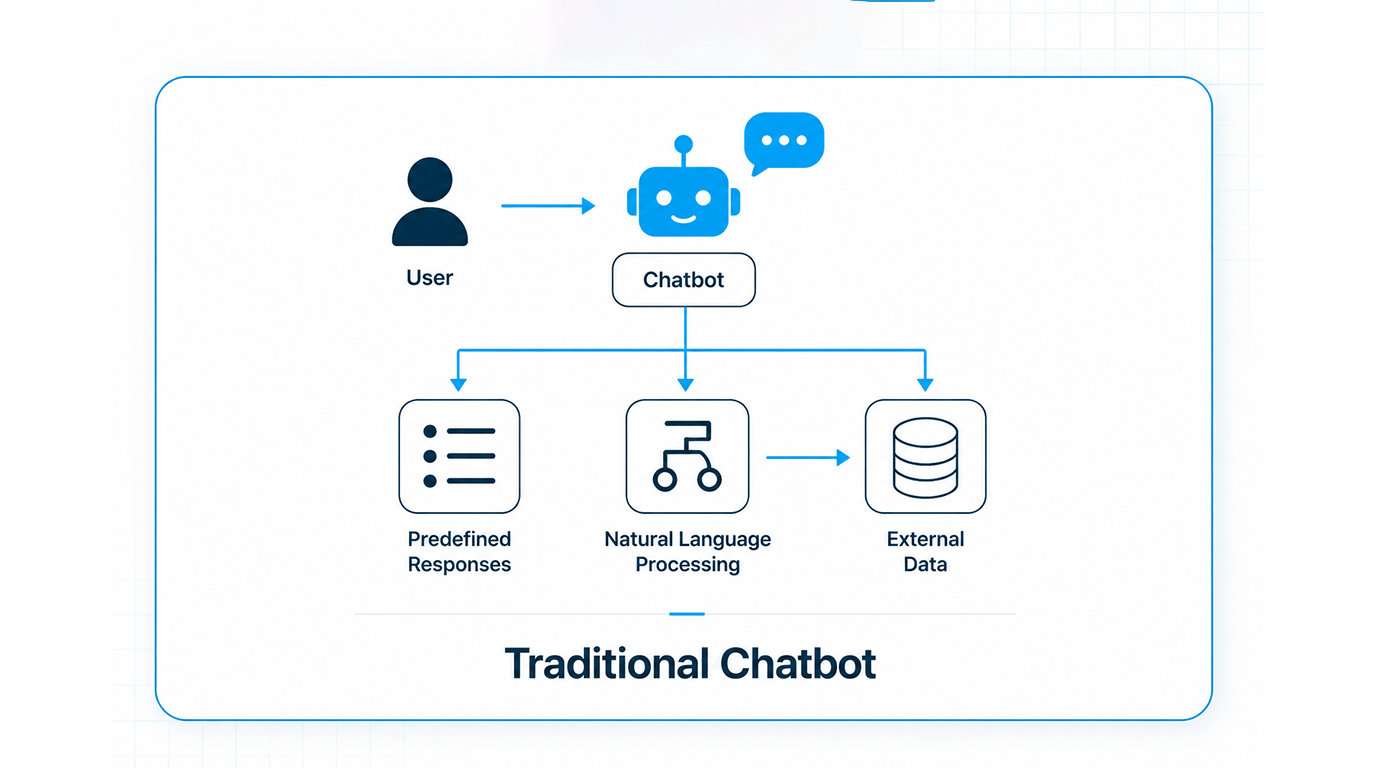
Traditional AI chatbots, commonly called rule-based or scripted chatbots, operate through a decision tree authored entirely by human developers. Every response the system can generate exists because someone wrote it. The chatbot analyses the incoming input and matches it with a library of predetermined keywords or intent categories and then provides the associated scripted output.
Nothing is inferred. Nothing is composed.
How Traditional AI Chatbots Work
By design, the flow is deterministic: the user provides a query, the engine maps it to known intents and returns a predetermined response. If the input goes outside of the accepted parameters, uses odd phrasing, is a compound query or is on an unlisted topic, the system falls back to a fallback message or passes the input to a human agent. There is no context memory between turns. Each trade is handled on a separate basis.
Features of Traditional AI Chatbots
- Responses governed entirely by static, auditable rules with near-zero output deviation
- High accuracy within predefined scope, provided queries stay within anticipated parameters
- Minimal computational requirements and comparatively simple hosting infrastructure
- Full output predictability, which simplifies compliance review
- Rapid deployment on structured workflows where query variance is genuinely low
Use Cases of Traditional AI Chatbots
Rule-based systems perform well on high-volume, transactional interactions with a narrow and stable query range: account balance enquiries, appointment confirmations, parcel tracking, and policy renewal reminders. Where every acceptable response can be enumerated in advance, they are often the most appropriate commercial choice.
Limitations of Traditional AI Chatbots
The problem surface becomes visible when users deviate from scripted paths. IBM's analysis of enterprise chatbot deployments identifies query deviation as the leading cause of chatbot failure in production, and in real customer interactions, variation is not the exception (IBM Think, What Are Chatbots?). A customer combining a complaint with an account query, or phrasing a common question unexpectedly, is not an edge case. It is routine.
As service complexity grows, the ruleset required to maintain adequate coverage expands proportionally, adding maintenance burden without improving fundamental capability. That trade-off resolves against traditional chatbots faster than most teams anticipate.
What Is a Generative AI Chatbot?
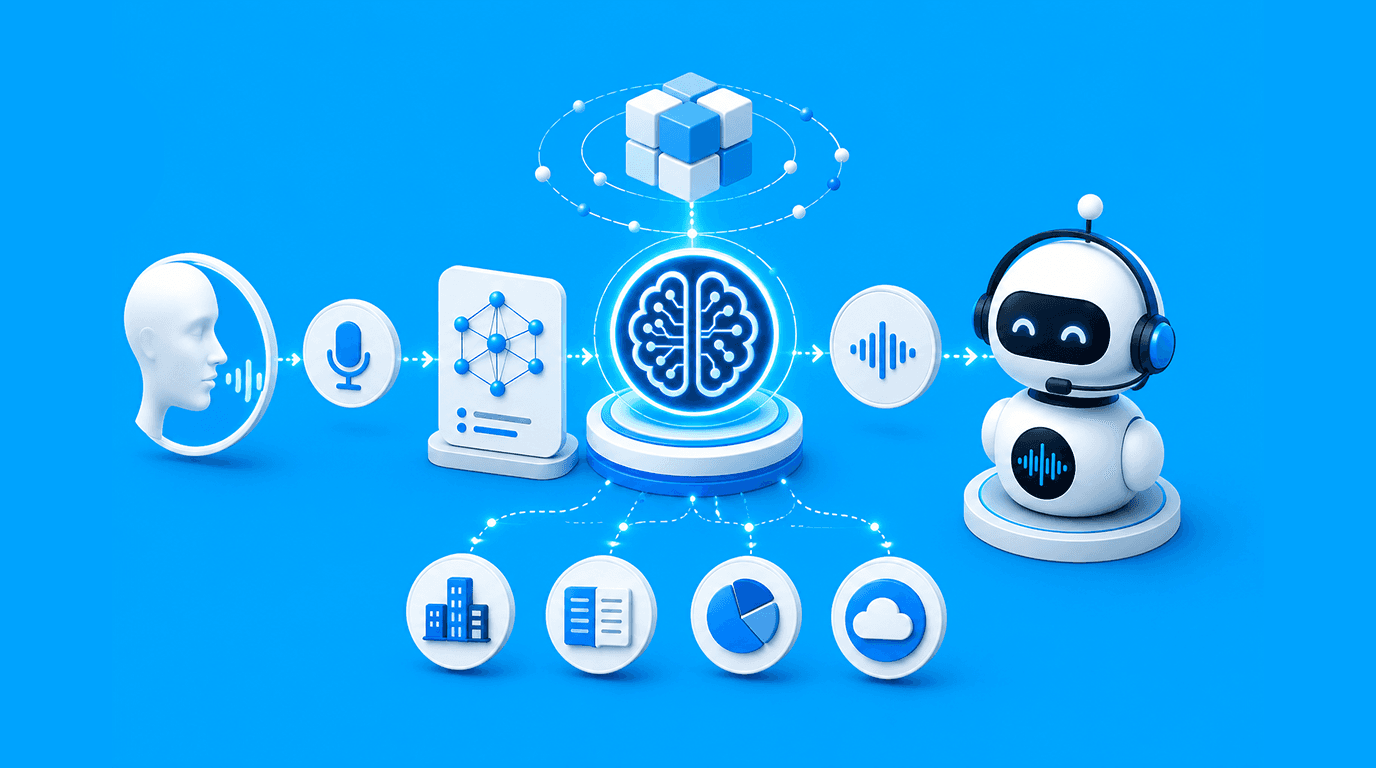
Generative AI chatbots are built on large language models trained across billions of parameters. Rather than retrieving a scripted response, the system constructs one, drawing on the full conversational history, semantic context, and probabilistic inference to generate a reply appropriate to that specific exchange.
That distinction changes the scope of what a chatbot can resolve.
How Do Generative AI Chatbots Work?
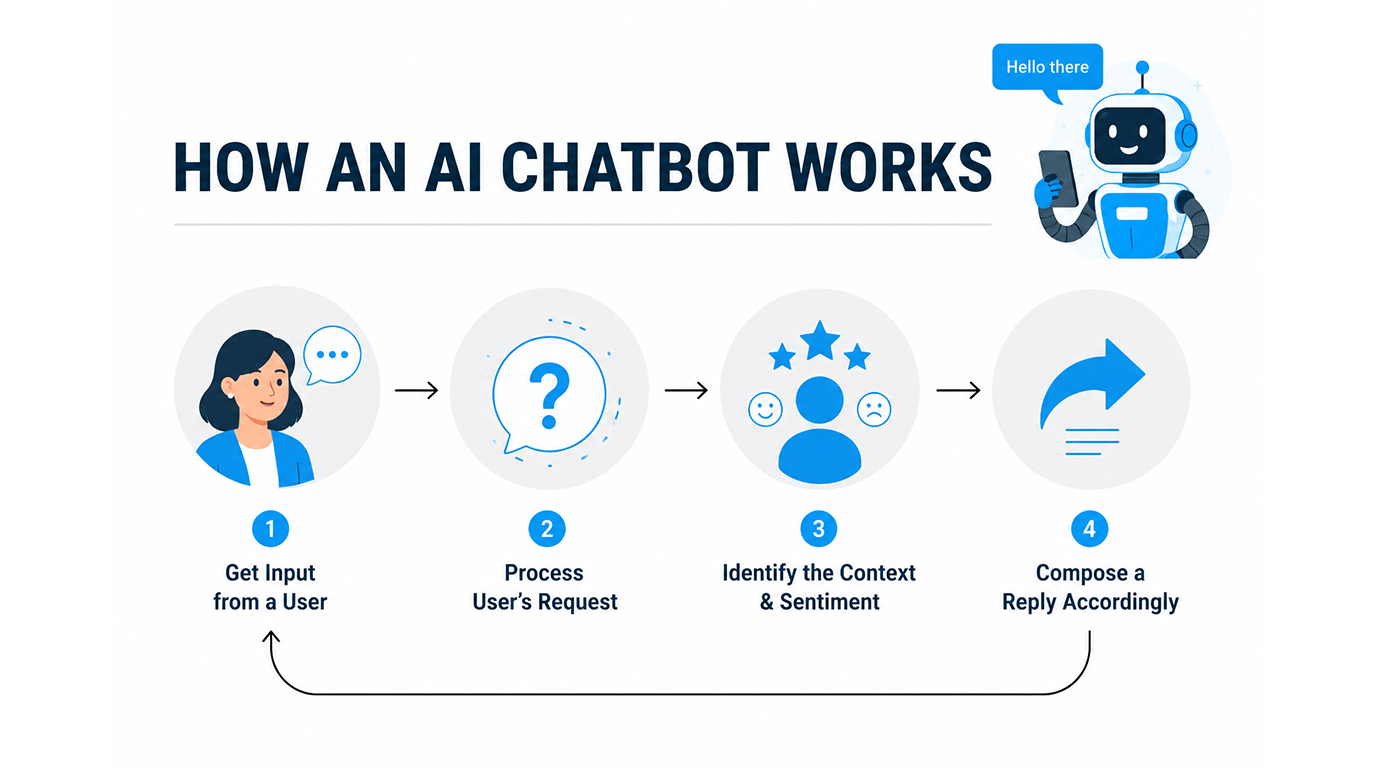
Transformer-based neural networks encapsulate the user's input into a high-dimensional representation, process it against learning parameters and generate a contextually coherent reply. Session memory is persistent between rounds, so multi-turn discourse is possible when the intent naturally changes, rather than being rejected as out-of-scope.
Capabilities of Generative AI Chatbot
- Context-aware answer creation that evolves over the conversation, not just the turn
- Semantic intent comprehension, not keywords matched, interpreted meaning
- Multilingual, ready to go. No language-specific rulesets needed.
- Enhancing domain capacity for sector-specific contexts under regulation
- Uniform treatment of query types, including new inputs not encountered during training
Generative AI Chatbot Use Cases
Deployment scenarios include complicated customer service, product discovery, technical troubleshooting, financial pre-screening, HR inquiry resolution, and claims intake. The commercial value is in areas where search is inconsistent, intent is multi-layered, and automated responses create high fallback or escalation rates.
McKinsey estimates that generative AI could automate up to 70% of business processes currently requiring human intervention, with conversational AI as a primary mechanism (McKinsey Global Institute, The Economic Potential of Generative AI). That figure warrants some caution, readiness varies substantially by sector, but it signals the directional shift in what enterprises now expect from conversational systems.
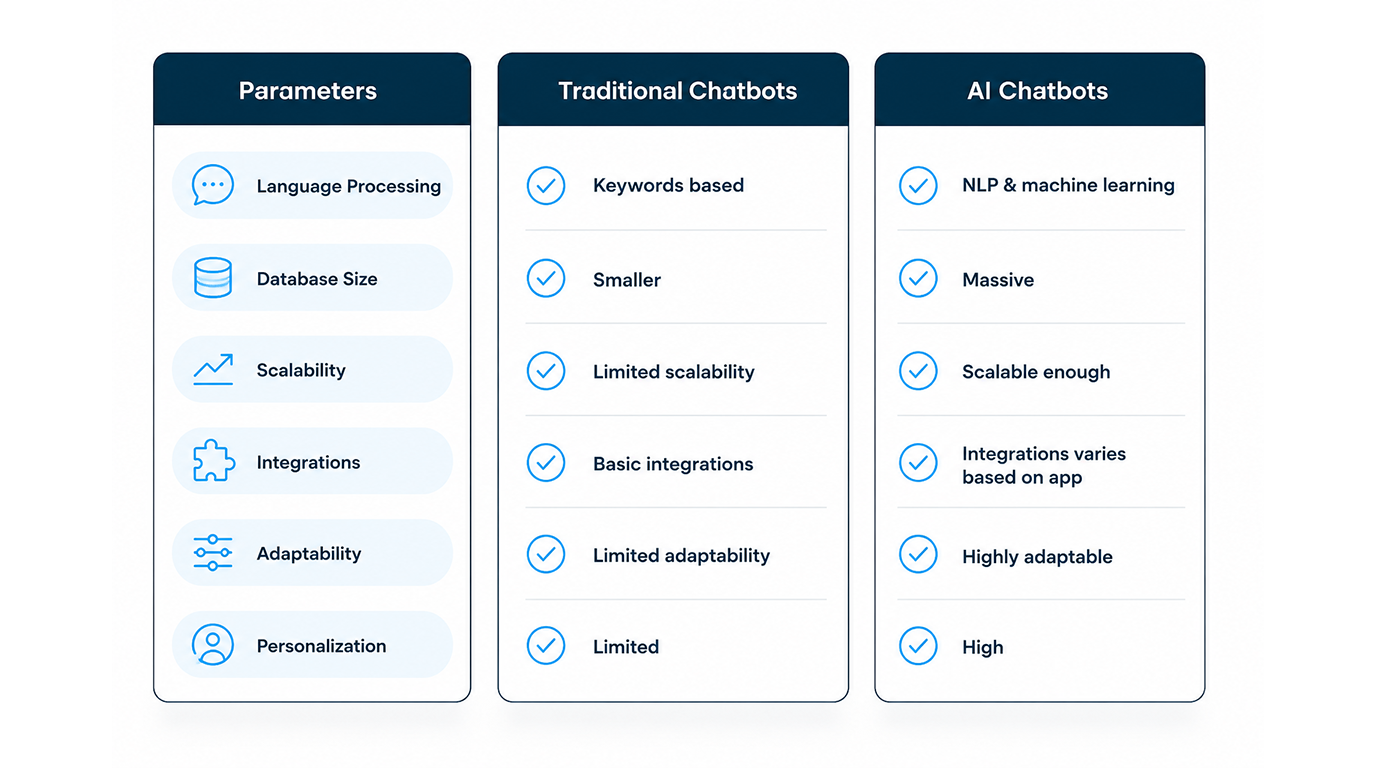
Comparison Table: Traditional vs Generative AI Chatbots
| Dimension | Traditional AI Chatbot | Generative AI Chatbot |
|---|---|---|
| Response mechanism | Rule retrieval from static library | Dynamic generation via LLM inference |
| Context retention | Stateless, each turn independent | Persistent session memory |
| Query scope | Predefined intents only | Open-ended, adaptive |
| Language handling | Scripted per language; manual upkeep | Native multilingual |
| Personalisation | None | Real-time, inference-driven |
| Scalability | Linear rulesets must grow with volume | Elastic, quality independent of volume |
| Initial deployment cost | Lower | Higher |
| Compliance auditability | High by default | Requires deliberate governance layer |
Context Understanding and Personalisation
Context handling is where performance divergence becomes most operationally visible. A traditional chatbot processes each message in isolation. A generative system understands what was said two or three exchanges earlier and adjusts accordingly. For a customer who mentioned an unresolved complaint several turns ago, that gap separates a resolved interaction from an escalation.
Personalisation, similarly, is not a feature layered on top of generative architecture, it emerges from it. The system adapts to stated context, inferred intent, and conversational history without additional engineering effort.
Gartner's research on conversational AI consistently identifies contextual continuity and response quality as the primary drivers of customer experience in automated service channels (Gartner, Generative AI). Rule-based systems generate friction precisely at the edges of their scripted scope, which is exactly where customers with complex needs arrive.
Advantages of Traditional AI Chatbots
Lower Deployment Cost
Initial configuration costs are meaningfully lower than LLM-based deployments. For organisations with narrow, stable use cases, payment confirmations, eligibility checks, and standard disclosure delivery, the investment differential is real and the performance gap in those specific contexts is relatively small.
Faster Setup and Maintenance
No model training means deployment timelines measured in days. Updating the system means editing a decision tree, not retraining a model. For non-technical teams managing a tightly defined interaction scope, that simplicity carries genuine organisational value.
Challenges of Both Architectures
Rule-based systems are brittle at query boundaries, expensive to maintain as product complexity scales, and structurally incapable of resolving interactions outside scripted parameters. These are not implementation problems. They are properties of the architecture.
Generative systems introduce a different risk profile: hallucination, tonal inconsistency at scale, and confidentiality exposure when model scope is poorly defined. None are intractable. Prompt engineering, retrieval-augmented generation, and model-level governance controls address each directly but require deliberate investment before deployment.
On data privacy: generative models with access to customer data require architecture decisions made at the design stage, data residency controls, zero retention defaults, and full interaction auditability. These are baseline requirements for defensible implementation, not optional add-ons for firms operating under India's Digital Personal Data Protection Act or sector regulators like RBI or IRDAI. Devnagri AI operates with configurable data residency and immutable audit logs across every conversational touchpoint, a relevant option for regulated enterprises that need multilingual conversational AI within a governed architecture.
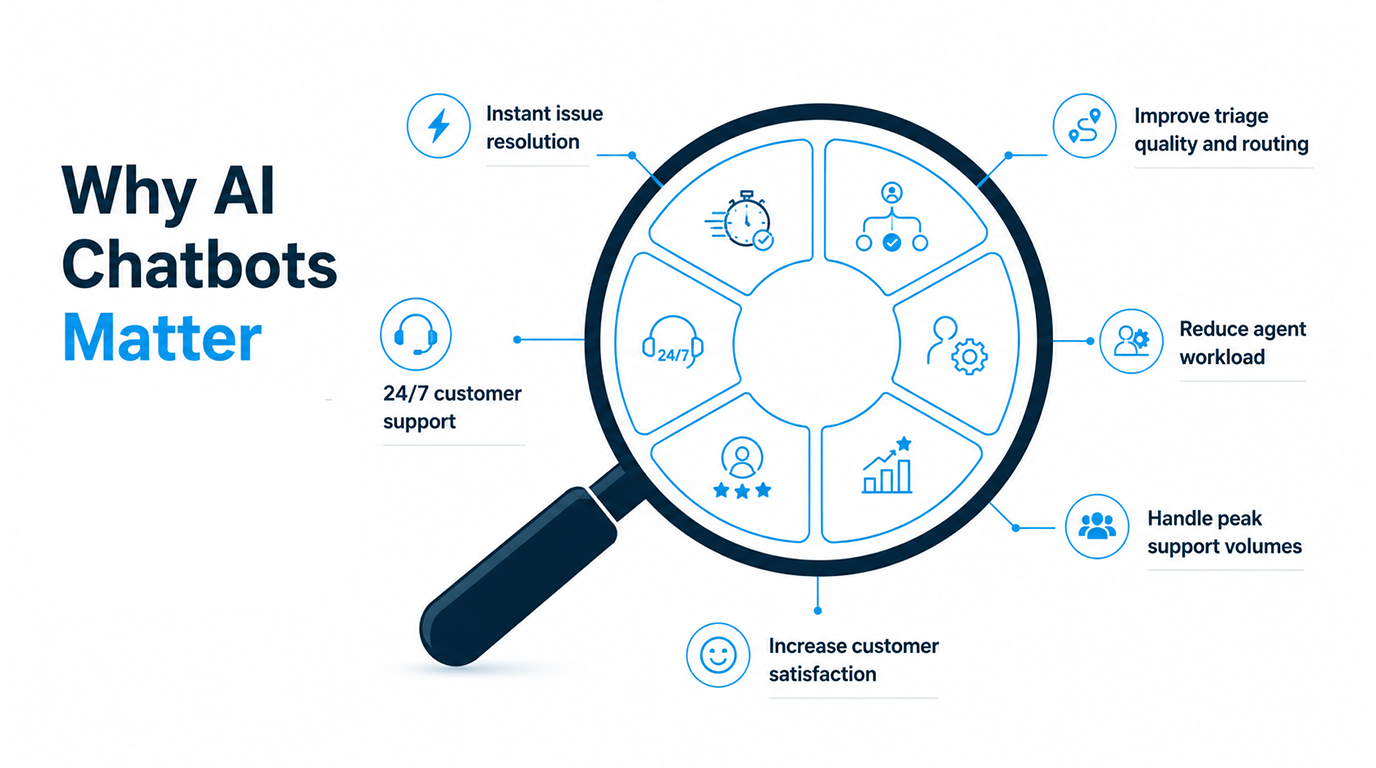
Which AI Chatbot Is Better for Businesses?
There is no single answer. The selection logic follows three variables: query complexity, linguistic diversity of the customer base, and compliance posture.
For narrow, transactional, high-volume use cases with stable query patterns, traditional chatbots remain commercially justified. For enterprises managing complex support journeys across multilingual markets, generative AI chatbots are structurally better suited but require commensurate investment in governance and domain calibration.
A growing proportion of enterprise deployments use both in combination. Rule-based logic handles compliance-critical interactions where deterministic output is a firm requirement; generative models manage open-ended queries where scripted systems fail. In many operating environments, that hybrid architecture is the most defensible option available.
Future of Generative AI Chatbots in 2026
Development is moving toward multimodal interaction, voice, text, and image within a single conversational thread. Domain-specific fine-tuning is reducing hallucination rates in regulated verticals. Retrieval-augmented generation allows chatbots to draw on live enterprise knowledge bases rather than static training data, addressing one of the most persistent deployment objections: that the model does not know what it actually needs to know.
For enterprise leaders, the strategic question has shifted. It is no longer whether to adopt generative AI chatbots, it is whether the surrounding governance infrastructure is mature enough to make the deployment defensible.
Conclusion on Traditional vs Generative AI Chatbots
Both architectures have legitimate enterprise applications. The question is not which is superior in the abstract, it is which fits the interaction complexity, customer diversity, and compliance requirements of a specific deployment context.
Traditional chatbots solve a bounded problem well. Generative AI chatbots solve a broader problem, but only when deployed with the governance infrastructure to make them enterprise-ready. Getting that distinction right is, in practical terms, what separates a chatbot deployment that delivers measurable business value from one that generates escalations, compliance exposure, and sustained customer friction.