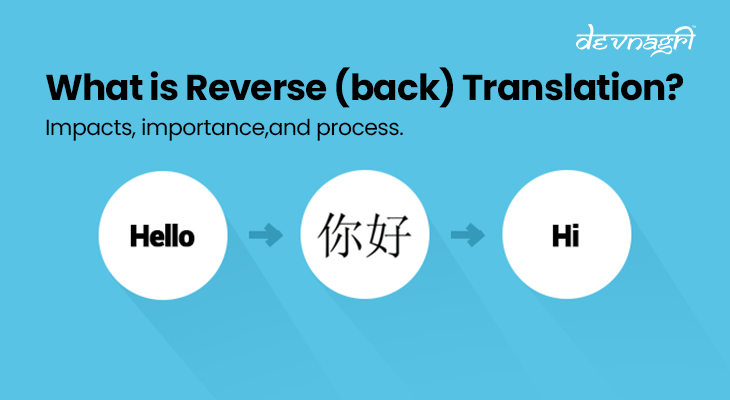
Also known as back translation, reverse translation involves rendering the contents into the original language and comparing them with the source text. This important localization quality control technique ensures software internationalization.
What is Reverse Translation?
The re-translation of material from the target language is reversed into the source language, for example, when performing English to Assamese translation or English to German for literal purposes, known as back translation or reverse translation. For instance, if the content were being translated from English to Swedish, the rewriter would have back-translated it into English so that the intent of that translated version would be immediately apparent. Reverse translations do not affect the translation memory or any other resources the translator may use, such as glossaries.
In specified circumstances, the retranslation or double translation becomes more critical, i.e., when the content includes taglines, slogans, titles, names of products, jokes, and puns. The reason is that such a difference in the content of languages is not implied to mean the same for another language or region. The back translation allows the content owner to scrutinize how creative liberties adapted the content to that of the market. Most often, the availability of this complex content warrants the translator’s offer of multiple options so the source content owner can make the most sensible decision for the brand.
This is often confused with double translation, in which a translator performs a piece of content in multiple ways to accommodate the nuances of various words and phrases.
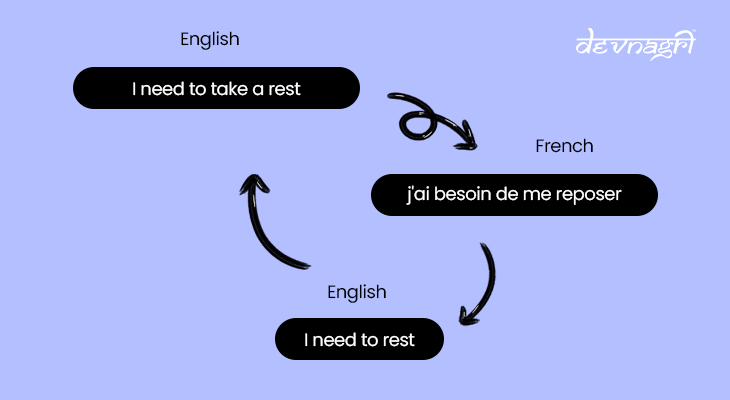
I need to take a rest – j’ai besoin de me reposer – I need to rest
English – french – english
Reverse translation is generally considered a method of quality assurance, and the Reverse translation process goes like this:
- Translate your content into the target language.
- Have another linguist do a rigorous, word-for-word translation of this text Reverse to the source language.
- Compare the Reverse translation to the original text to ensure the Reverse translation is accurate and complete.
- When you finalize your reverse translations, you may commence a reconciliation process to resolve any discrepancies, correct any errors, and finalize your translation.
Quality assurance is an essential part of any translation process. One way to rate quality is to review Reverse translations, especially when multiple translation possibilities are involved.
The best types of Reverse-translated content
When a blog post is translated, its content still expresses the source germ, so reverse-translated content should not be needed. The language should not be changed multiple times from the original message.
Often, translators change idioms, analogies, or references that relate more closely to the culture they are writing for. This may include restructuring sentences or even paragraphs and sometimes swapping content. Images such as this will mostly keep the original idea and even wording.
Yet other types of content require Reverse translation when you are doing French to German or English to Assamese translation. Industries with high-stakes content sensitive enough to demand perfection, such as medicine, where a single translation error could turn life into death, arguably need Reverse translation. Particular states have regulatory, ethics review committee, and institutional review board requirements for their industries that, per their policy, apply to any translation process.
That includes content like:
Medical: Clinical trials, pharmaceutical companies, clinical research, medical devices, and consent forms.
Data: Survey results, questionnaires, polling, and research.
Legal: Contracts, legal documents and instruments, case files and other necessary paperwork, insurance policies, and other binding documents.
Also Read: https://devnagri.com/easy-english-to-assamese-translation-in-assam-using-devnagri-ai/
When should we use the Reverse translation solution, and when should we not? Reverse translation can be valuable in your localization strategy but may not cater to every company or project. For most of your requirements, like media translation, eLearning translation, and banking finance translation, a well-trusted localization partner such as Devnagri AI would provide peace of mind with automated reporting and intensive quality checks that help ensure high-quality output.
Why Use Reverse Translation?
Here are some reasons: You work in a highly regulated industry such as financial services, healthcare, or insurance, where you must exert considerable effort to manage risks or meet regulatory requirements. Your concern is much less for creativity, style, or expression than accuracy and precise terminology. You have time and dollars. Reverse translation introduces another layer, taking time for different languages to finish.
Final thoughts on Reverse (back) Translation
Reverse translation can improve accuracy, especially in complicated Asian languages like Assamese, Odia, Bengali, and more. It is also useful in high-stakes industries such as media translation, eLearning translation, banking finance translation and even creative content. English to Assamese translation using the Reverse process helps identify discrepancies and potential issues, preserves original intent, and keeps translations relevant across cultures.
It does add to the cost and time of your project; however, it is essential where great precision is needed. For instance, commissioning a creative campaign can make the difference between a campaign that falls flat and one that engages international audiences.