Expanding into new markets sounds exciting on paper. More customers, more money, and a larger footprint around the world. But when you’re doing it, the problems can seem a lot bigger than what the spreadsheet says. It is not only about getting your product into another country. It is about ensuring that the message, experience, and trust travel along with it. That is where the three ideas that many business leaders mix up come into play, globalization, localization, and glocalization.
Globalization is about thinking big, aligning operations for scale across borders. Localization is the opposite in a way, zooming in to match the nuances of a specific market. Glocalization aims to strike a balance, creating something that feels local while running on a global backbone. Each approach has its own benefits, but none of them will succeed without the right communication layer. And here is the part that most decision makers underestimate the quality of that communication often depends on translation technology.
Highlights:
- For firms that want to grow, becoming global is no longer a choice.
- Companies struggle to access markets that speak different languages and have distinct cultures.
- Talk about globalization (broadening your reach), localization (making your product fit the local market), and glocalization (combining global reach with local personalization).
- Translation technology is very important for swiftly and effectively breaking down linguistic barriers.
- Thesis: Companies that use current translation tools as part of their growth plans have a distinct edge over their competitors.
If you picture a company trying to win over Marathi-speaking customers in Maharashtra, the first touchpoint is rarely the product itself. It is the language on the website, the tone in a marketing email, or even the way a support chatbot replies. That is where English to Marathi translation, whether handled by a skilled website translation agency or supported by a reliable machine translation API, becomes a business tool rather than just a linguistic service. Because in competitive markets, every misunderstanding is a lost opportunity, and those tend to add up faster than you think.
Translation sits at the heart of this balancing act. It is not a marginal cost. Embedding translation into your strategy is what warms up customers before they even browse. For brands that want to enter Maharashtra, consider translating English to Marathi. Or, for instant coverage across languages, use a machine translation API. These are not just tools, they are strategic shifts. Translation choices can determine whether expansion hits resistance or finds resonance.
1. The Business Case for Global Communication
Let us be clear. Global markets are no longer distant fantasies, they are exhausting to compete in if your messaging is off. Shine internationally, yet falter locally, and you may as well not have gone global at all. That stops being surprising when you think about how much trust lies in clarity.
The stakes grow steeper. Imagine a brand in India, its national e-commerce industry hit $147.3 billion in 2024, with projections showing around 18.7 percent CAGR through 2028 (CSA Research). That is not a side market. There is a race to determine the best approach to talk to people. Companies that offer advanced translation, such as English into Marathi Translation for Marathi speakers, do more than merely select a box for cultural reasons. They change, keep, and build trust.
This is what I’ve seen. Companies that don’t consider translation until the last minute often perform well initially, but their message gets lost when competitors speak the local language first. Companies that include localized translation in their globalization plans can get into new markets quickly and in a way that makes sense.
2. Localization vs Glocalization Strategies
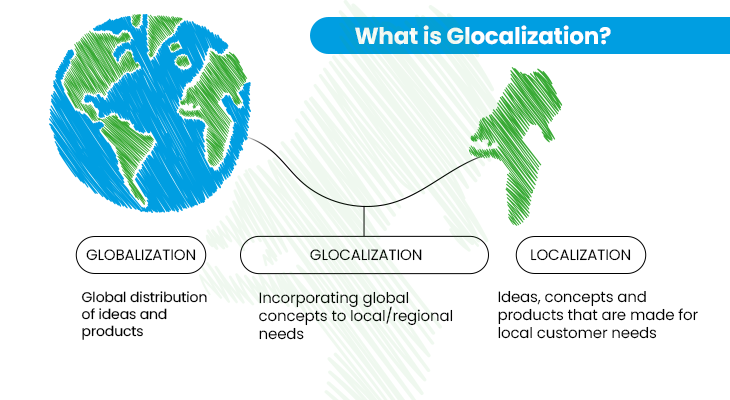
You might wonder: why not just go global with a single message? Because culture is stubborn. Localization adapts, making language, imagery, and messaging fit the local culture. Glocalization aims to maintain the brand’s identity while adapting to local contexts. Both have worked for us, depending on whether we value consistency or authenticity more.
Native-language preference matters. According to OneSky, 72 percent of consumers are more likely to buy from native-language websites, and 87 percent refuse to buy from English-only sites (CSA Research).
- Localization involves adapting language, currency, images, and cultural references to suit a specific region.
- Glocalization means keeping the fundamental brand identity but making it fit with local tastes.
- For example, the McDonald’s menu in India has the McAloo Tikki burger.
- Netflix is creating content that is exclusive to certain regions, yet remains popular worldwide.
India’s regional diversity means localization is not optional. For instance, in Maharashtra, where over 83 million people speak Marathi, strategic English to Marathi translation can significantly improve engagement and sales in that segment. Meanwhile, glocalization preserves brand integrity while offering local rhythm. Imagine the same logo and storefront design, but with regional festival deals and a casual tone in Marathi that connects the business and the buyer.
Truth is, the brands that do this well don’t just get noticed, they get remembered. They avoid the “off-message” trap and instead live in consumer conversations. That voice, human, localized, but consistently branded, is what consumers engage with. That is staggering resistance. Meanwhile, a broader CSA study underscores that 76 percent prefer purchases in their language, reinforcing how essential translation is (Newswire).
3. Technology Solutions for Modern Translation Needs
Content never stops; it moves quicker than translation teams can keep up with. That’s where a machine translation API comes in: it’s quick, can handle a lot of traffic, and is always on. It can add translations to CMS in real time, even if the first draft requires some work. But if you don’t keep an eye on it, the tone slides. That’s when a translation firm for websites comes in to edit, polish, and make sure that cultural differences are taken into account. What happened? Output that works well and makes you feel something.
Machine translation’s accuracy went from 74% in 2017 to 85% in 2023. It simply takes a few days to change a big website into multiple languages, not months. Businesses can use hybrid models to establish a balance between speed and quality.
Those numbers suggest acceleration. I have sat in boardrooms where translation costs were a surprise. Once CTOs and CMOs realize that a hybrid model, API plus human, saves cost while driving quality, everyone leans in. You launch markets faster, preserve brand tone, and scale smartly.
For English to Marathi translation, this hybrid model is especially powerful. Agencies build regional glossaries adapted for Marathi idioms and tone. Machine output offers the base, and the agency edits it to fit cultural expectations. The outcome is a translation that sounds locally fluent yet aligned with global identity.
Conclusion
Globalization gives you reach. Localization gives you resonance. Glocalization keeps your brand coherent while speaking regional dialects. But none of that matters if people cannot understand or trust your message. That is why translation, from English to Marathi translation on regional pages to real-time workflows via machine translation API and expert agency oversight, must be central in your strategy.
Global expansion requires more than just product availability; it demands cultural and linguistic adaptation. Translation technology helps scale without compromising customer experience.
Decision-makers should have clear next steps:
- Check how ready you are for multilingualism right now.
- Find the most important markets and languages.
- Select a translation partner or API that meets the needs of your organization.
Future trend: AI-powered translation with integrated cultural intelligence will dominate cross-border commerce. If you are gearing up for expansion, start by auditing your language touchpoints. Then pilot a machine-plus-human translation approach for one strategic region. Measure engagement, conversion, and sentiment. Then scale. The brands that treat language as a strategic asset, rather than a checkbox, gain momentum in markets others view as competitive barriers.
Digital platforms are global. Language is local. Translation bridges them. Now is the time to build those bridges skillfully.