In most boardrooms, document translation still sounds like a tactical decision. A tool choice. A procurement line item. Something that sits somewhere between IT and communications.
That assumption no longer holds.
By 2026, document translation is profoundly tied to regulatory exposure, consumer trust, and operational resilience, especially for national BFSI and government entities. English to Hindi translation has gone from “regional enablement” to “regulatory hygiene.”
What changed is not language itself. It is volume, velocity, and visibility.
Documents that were once static, policy PDFs, circulars, disclosures, now move continuously across digital onboarding journeys, grievance flows, WhatsApp updates, mobile apps, and audit systems. Every translation decision now compounds. A single inconsistency does not just confuse a user; it travels across systems, escalations, and regulators.
This is why the question in 2026 is no longer “Which tool translates best?”
It is ‘Which translation system can be trusted when things go wrong?’
This blog looks at the top 5 document translation tools in 2026 through that lens, grounded in BFSI and government realities, not feature checklists.
The Landscape Shift Most Enterprises Underestimated
A quiet pattern has emerged across Indian enterprises.
Teams invested heavily in digitization, apps, portals, workflows, assuming language would “fall into place.” Initially, it did. English-first launches, followed by Hindi versions, often built manually or using generic AI tools.
Then the scale arrived.
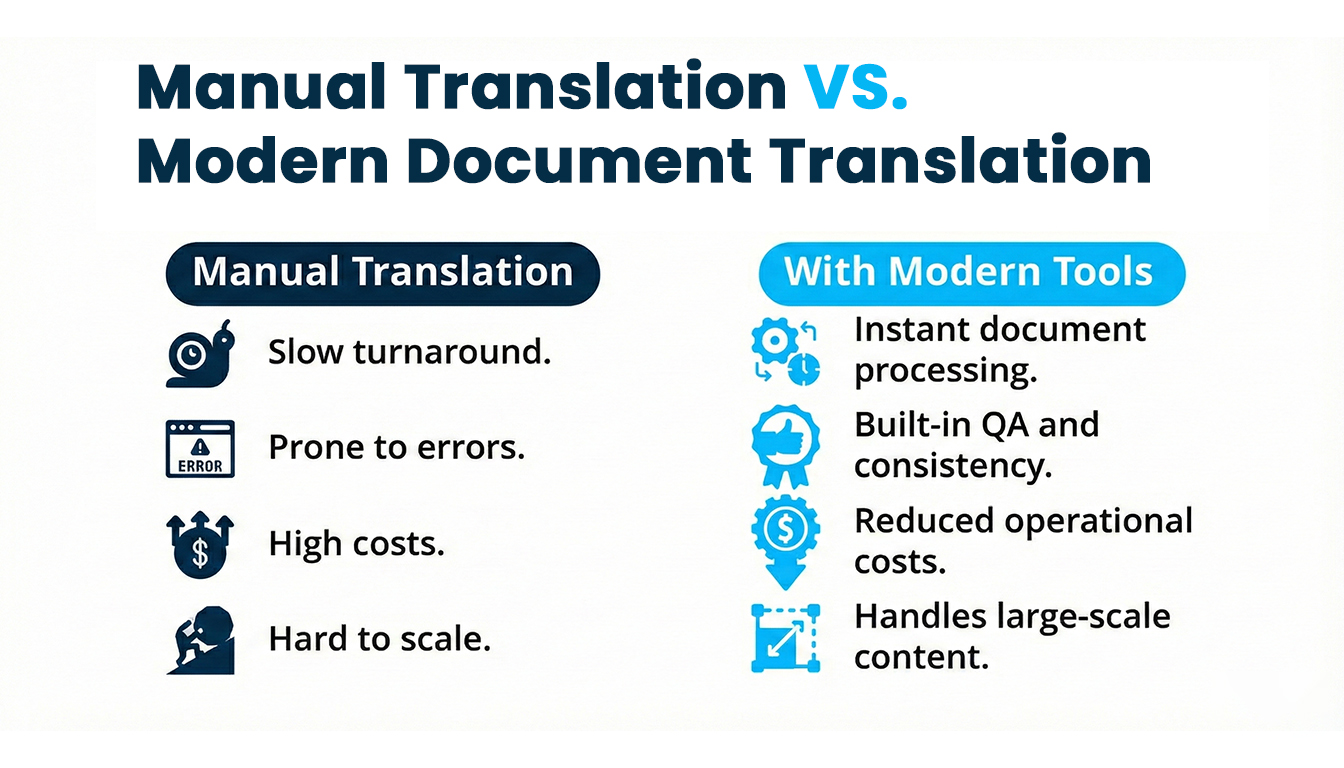
More documents. More revisions. More circulars. More exceptions. More audits.
At that point, translation stopped behaving like content and started behaving like infrastructure. And infrastructure failures are rarely loud at first. They show up as small cracks:
- A clause translated differently in two documents
- A customer escalation citing “misleading Hindi text”
- An audit question that takes days to answer because no one knows which version was approved
According to Deloitte Insights, many compliance failures in regulated industries are not caused by bad intent, but by fragmented processes and inconsistent documentation across systems.
Translation workflows sit squarely inside that risk zone.
Why English to Hindi Translation Is Especially Sensitive?
It is tempting to treat Hindi as the “easy” Indian language.
In practice, English to Hindi translation is where most BFSI and government teams make costly mistakes.
Why?
Because the Hindi used in regulatory, financial, and policy contexts is not conversational Hindi. It is formal, precise, and often legally loaded. Slight wording changes alter interpretation. Tone matters as much as meaning.
This is also where generic AI translation tools struggle. They optimize for fluency, not defensibility.
As Gartner has noted, poor localization is increasingly a leading cause of digital friction and trust erosion in regulated industries, particularly in emerging markets where language diversity intersects with regulation (Source).
The implication is uncomfortable but necessary: translation quality is no longer subjective. It is auditable.
How CXOs Are Reframing the Decision in 2026?
A continuous shift is seen in BFSI and government leader talks.
- They no longer inquire about the number of supported languages.
- “How fast is translation?”
- “Can we defend this translation six months later?”
- “Can we track who approved what and why?”
- “Can this scale without breaking tone or compliance?”
Instead, they inquire,
This shift aligns with broader AI adoption patterns. McKinsey’s research on AI in operations shows that organizations see meaningful value only when AI is embedded into core workflows with governance, not deployed as a standalone utility (Source).
Translation is following the same path.
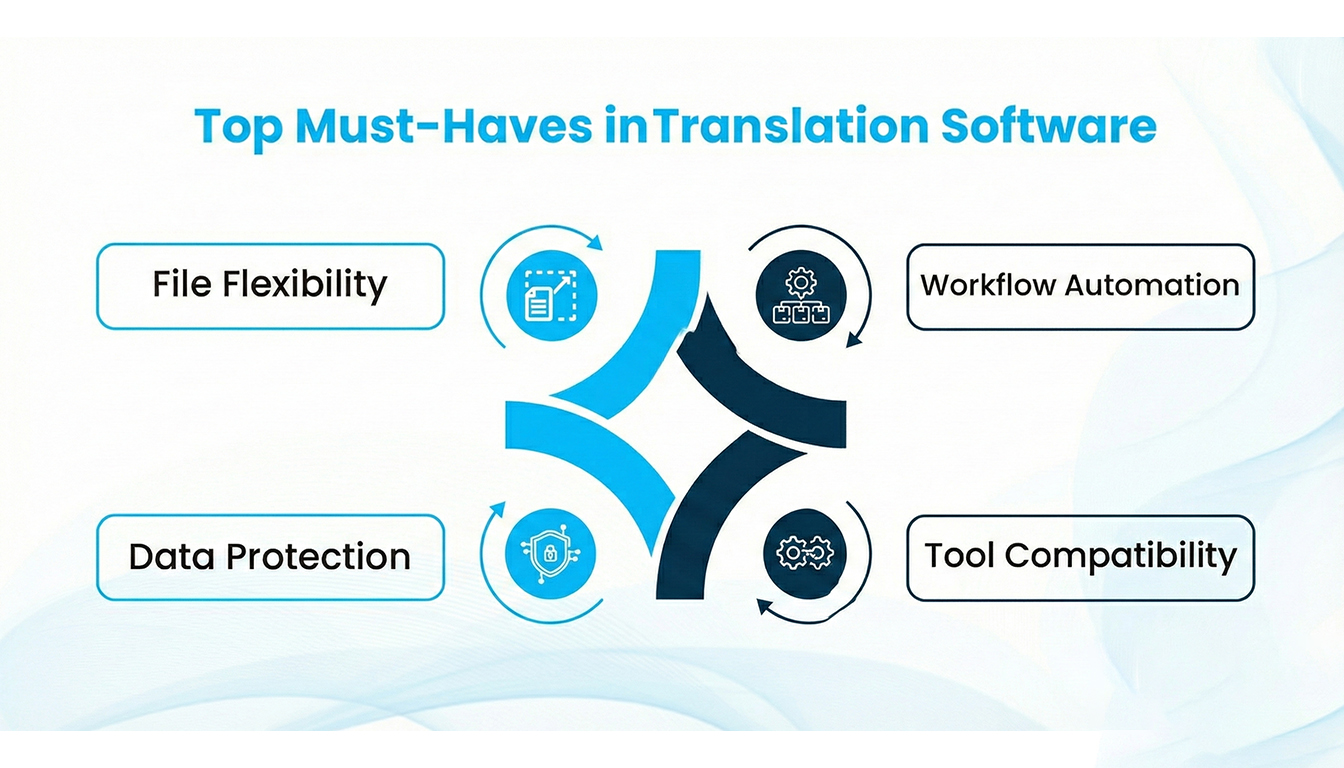
The Top 5 Document Translation Tools in 2026
Explore the top AI powered translation tools for enterprise requirements in 2025, that can automate your document workflows at the same time scaling them to while enhancing the document handling proficiency.
1. Devnagri AI – Built for Indian-Scale, Regulated Reality
Devnagri occupies a different category from most translation tools, mainly because it does not treat translation as an isolated task.
It functions as a multilingual intelligence infrastructure layer, explicitly designed for Indian enterprises operating under regulatory pressure.
What stands out in practice is not just translation quality, but control:
- Domain-tuned English to Hindi translation
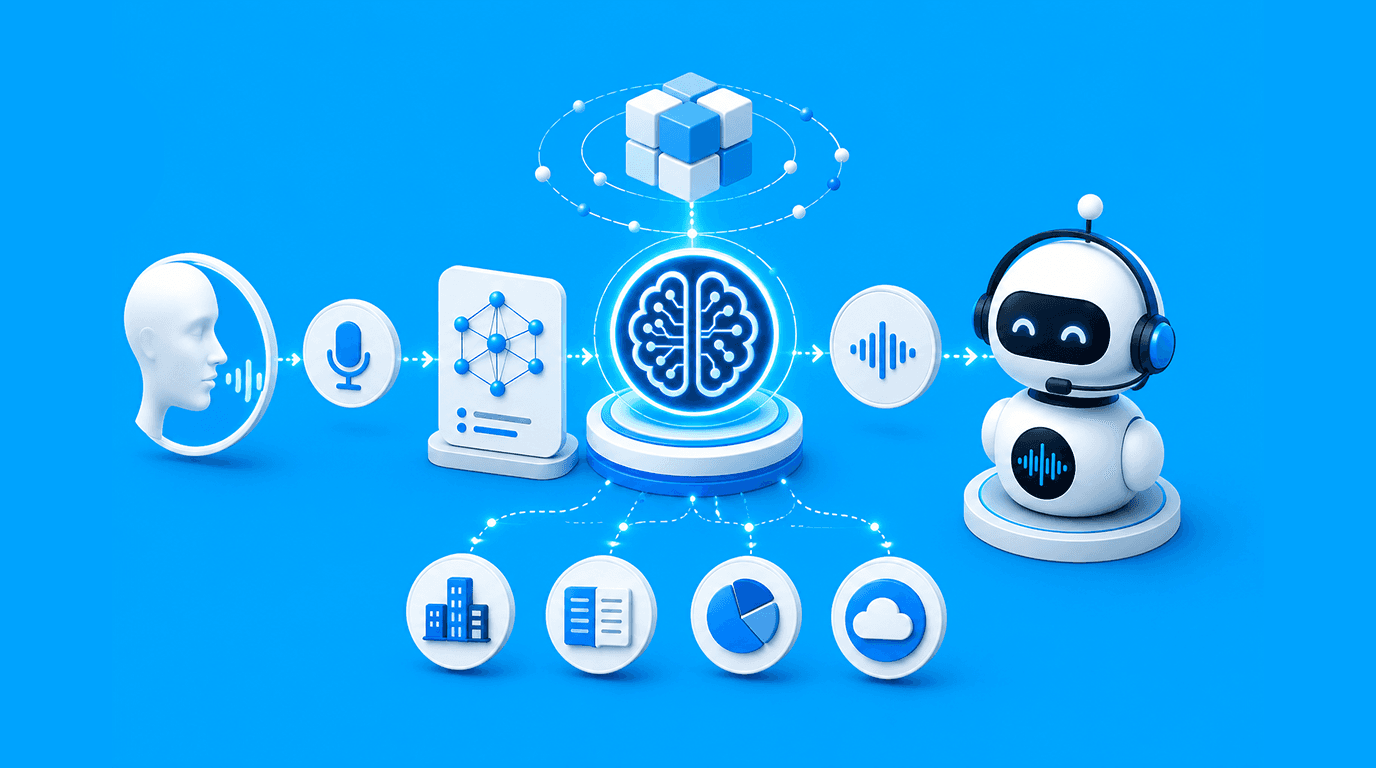
- Glossary and tone enforcement through BRAIN/DILM
- Review workflows and audit trails built into the system
- Deployment flexibility: on-prem, VPC, or hybrid
For BFSI institutions and government departments, this matters because translation is rarely the end goal. The goal is consistency across onboarding documents, service communications, disclosures, and legal text, over time, not just at launch.
Devnagri tends to be adopted where language errors carry institutional consequences, not just CX penalties.
2. Centus – Scale Without Depth
Centus are fast, scalable, and linguistically competent for general content. For enterprises dealing with massive volumes of non-sensitive documents, they can be effective.
The limitation appears in regulated contexts. Centus strength is breadth, not depth. Glossary controls, auditability, and domain nuance require additional layers.
In BFSI and government environments, it is often used as a supporting engine rather than a system of record.
3. Microsoft Translator – Productivity-First Integration
Microsoft Translator integrates well with Office, SharePoint, and Azure.
This connection streamlines government agency Microsoft infrastructure use. Core product and translation governance differ. Regulatory translation adjustment from English to Hindi often requires outside help.
This works best for frequent, non-legal translation. Mature enterprise security and access controls.
4. SDL Trados with AI Extensions – The Legacy-Modern Hybrid
SDL Trados continues to appear in regulated environments because it reflects how translation used to be managed: carefully, manually, and with human oversight.
Translation memory and methodical review are its strengths. Operational cost and speed are weaknesses.
It thrives in moderate translation volumes and low risk tolerance in 2026, but it struggles in always-on digital processes.
5. Cockatoo
It scales well and integrates smoothly with cloud pipelines.
That said, like most hyperscaler tools, it assumes translation is a technical function, not a governance challenge. Enterprises must build their own review, compliance, and audit layers around it.
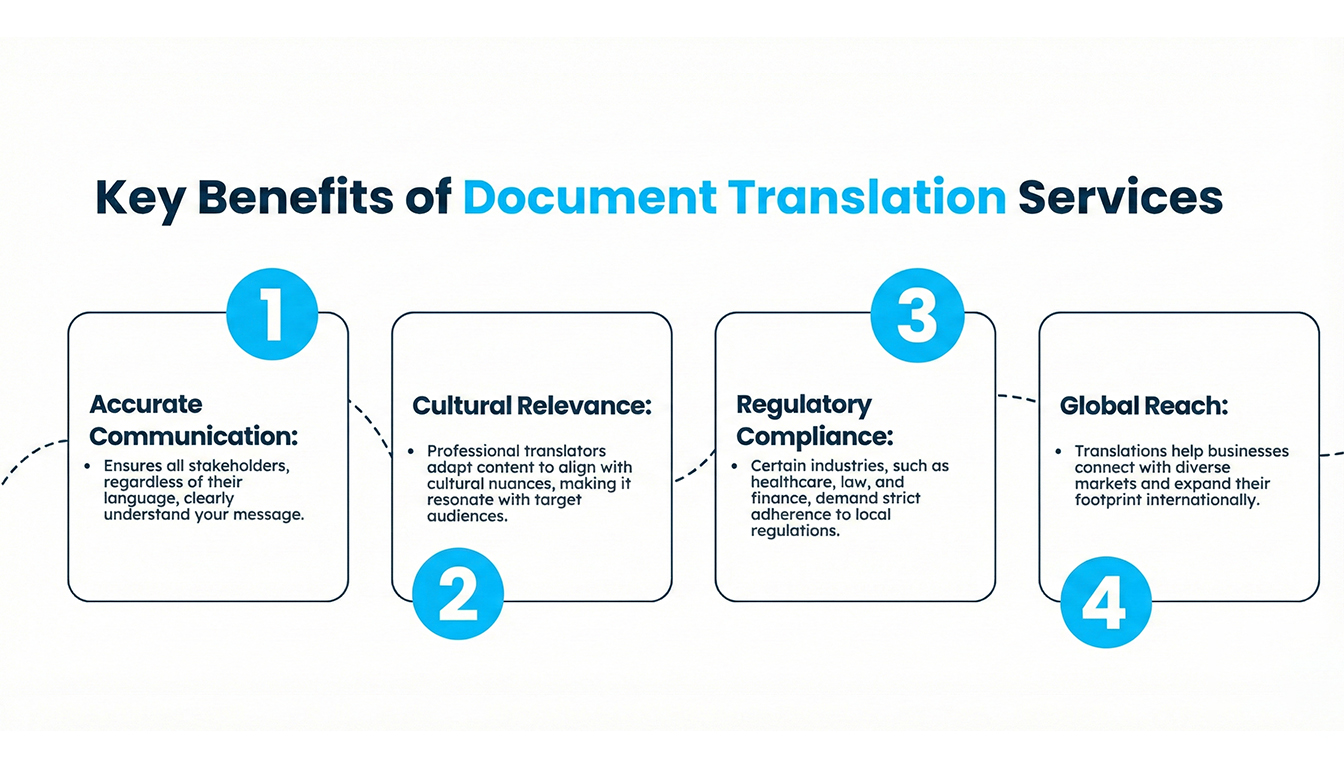
Opportunities Enterprises Are Unlocking
When document translation is treated as infrastructure, several second-order benefits emerge:
- Faster regulatory communication cycles
- Reduced rework and internal clarification loops
- More confident regional rollouts
- Lower grievance volumes driven by language ambiguity
These gains are incremental individually, but compounding at scale.
The Risks Most Teams Still Miss
The most considerable risk in 2026 is not bad translation. It is an inconsistent translation over time.
Documents evolve. Policies change. Circulars get amended. Without a governed system, language drifts. That drift becomes invisible until something breaks.
Another risk is tool sprawl. Different teams using different translators create silent fragmentation. No one owns linguistic consistency anymore.
These risks are rarely caught in pilots. They surface months later, often during audits.
Strategic Guidance for CXOs
If there is one shift leaders should make, it is this:
Stop evaluating translation tools as software. Start evaluating them as institutional systems.
Ask uncomfortable questions:
- Who owns language consistency today?
- Can we explain a translation decision to a regulator?
- What happens when documents are revised across languages?
The answers reveal whether translation is a capability, or a vulnerability.
Where Devnagri Fits, Practically
In many enterprises, Devnagri is not positioned as a replacement for every global tool. It is positioned as the control layer, the place where compliance, tone, and Indian language nuance are enforced.
That distinction matters. It reflects how translation actually operates in complex organizations.
Closing Thought
Translation is no longer about making text understandable.
It is about making institutions trustworthy, across languages, systems, and time.
“In regulated environments, language is not a layer you add. It is a foundation you either get right, or keep paying for.”