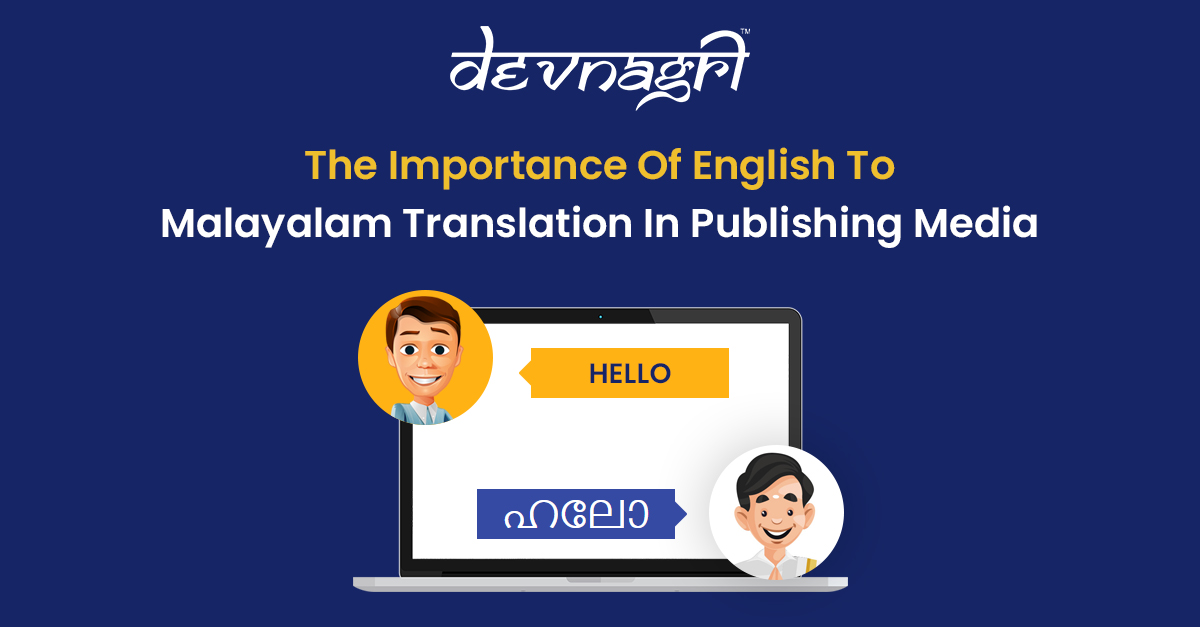
We are living in a multilingual world, where the translation is crucial to ensure that you pass on accurate messages from one end to another. Multilingualism paves the perfect direction for businesses in the foreign economy, especially in industries like the publishing media.
Media is a vast field including all types of information such as promotional, advertisement, social media posts, mass media campaigns, and much more. By translating, one can enhance their capability to gain more audience, eventually leading to more sales.
Malayalam is a widely spoken language in India in the state of Kerala. It is one of the Dravidian languages. According to the latest census, the language is spoken by around 33 million people. Translating content to Malayalam is essential for the publishing media industry. English to Malayalam translation made it easy for platforms to introduce their content in regional markets.
Also Read: Is Website Localization Important For Edtech Companies In India?
Converting a message from one language to another is the prime component to reach the general population. English to Malayalam translation has localized publishing media platforms to re-use the content and amplify its reach to the Malayalam-speaking audience.
In this blog, we will discuss the importance of English to Malayalam translation in publishing media.
Bridges language gap:
English to Malayalam
translation helps to bridge the communication gap. Expert translators have
a vast knowledge of the cultural nuances of the target population and,
hence, deliver the best output possible.
Expand your clientele:
The primary reason to
translate your business materials is to reach a more comprehensive portion
of the audience. There are various ways to boost traffic with
Malayalam-speaking regions, but the most potential way is to convey your
content in their native
language.
Also Read: Why Is The Banking Sector Availing English To Hindi Translation Solutions?
Increases brand value:
It is almost impossible to
retain the brand value high because you are dealing with various phrases,
cultures, traditions, and native languages. Any misinterpretation or
misleading information could destroy the brand value, and consumers will
question your business authenticity.
Through English to Malayalam
translation, all your information and data are conveyed accurately with
the essence of the original documents.
Enhanced visibility among domestic players:
A
significant advantage of having a translation agency alongside your
publishing media business is that it helps to differentiate yourself from
others. People prefer and trust products that are adapted to their native
language. Translating your content from English to Malayalam will help
native Malayalam
speakers to get to know you and your business.
Encourages collaboration:
Several events happen in a
year, bringing people from around the globe. Accurate translation is a
must to participate in media events. English to Malayalam translation
allows you to participate and collaborate with other businesses.
Collaborating helps you to gain the consumers of the other businesses,
which increases views and traffic to your website.
Also Read: How Has Translation API made The Process Easy For Various Industries?
OTT translation:
Media platforms are gaining immense
popularity due to the entertainment quotient it carries and the quality of
content. The rise of OTT platforms has changed the game in the
entertainment industry. It has encouraged production houses to refine the
quality of their content. OTT has started translating content into various
languages. To reach more visibility of content, the global OTT players are
translating the media into different regional languages. Translating
content into local languages increases the viewership of the content.
OTT translation ensures that information is related to linguistic nuance and aligns with the viewer’s environment. To survive in large international and regional OTT platforms, one has to adapt its content into regional languages to meet the local demand. OTT translation gives the desired competitive edge and allows OTT players to compete on a larger scale.