Global expansion used to mean opening offices overseas. Today, it means being relevant in every language, on every screen. And that's where many companies get confused, standardize or localize?
Standardization offers the comfort of control and efficiency. Localization brings depth, emotional resonance, and a path to market intimacy. So, what's the more brilliant move? The answer is more than binary but strategic.
A CSA Research study revealed that 76% of consumers prefer buying products with information in their language. Even more compelling, 40% won't buy if the content is only in English. For instance, companies looking to penetrate high-growth markets like Punjab, overlooking English to Punjabi translation, can mean lost ground and missed ROI.
Why This is not a One-Size-Fits-All Decision?
Not every product, audience, or market warrants the same strategy. Industries like banking, finance, and mobile technology face heightened pressure to deliver regionally relevant experiences. For them, localization is more like table stakes.
Let's explore where standardization fits, where localization wins, and how AI-powered solutions like mobile app translation and website localization bridge the gap.

Banking and Finance: When Trust Speaks in Local Tongue
Financial services hinge on clarity, legality, and emotional security. A standardized platform ensures compliance, but it rarely speaks the language of trust.
Customers in tier-2 and tier-3 cities do not just want translations. They need communications that feel native. A fintech firm offering a savings product in Punjab will gain more traction when its mobile app and disclosures are fully localized. That means more than substituting words; it means aligning with cultural context and financial literacy levels.
Companies deploying robust banking finance translation solutions often see faster user onboarding and fewer customer support escalations. That translates directly into lower acquisition costs and better customer satisfaction scores.
Mobile Apps: Interface Meets Communication
Apps are not websites. They're lived experiences. Every swipe, notification, and pop-up is a conversation. And conversations do not work if you lose nuance.
Direct translation of interface elements often leads to confusion or even offence. For example, an alert that says "invalid entry" may need softer wording in certain cultures. Or a call-to-action that performs well in one region may flop elsewhere if it clashes with local behavioral patterns.
That's why mobile app translation is more than just text. It is tone, flow, and intention. Businesses that go the extra mile to localize in-app experiences, including support content and microcopy, tend to see higher retention rates. According to Gartner, localized mobile apps see a 1.5x increase in user stickiness over time.
Where Standardization Works, and Where It Does Not
Standardization shines in backend operations, security models, and technical documentation. In these areas, uniformity ensures scalability and operational harmony. For SaaS providers or B2B platforms, offering a single, consistent product UI might be a selling point.
But here's where many leaders get tripped up: mistaking backend uniformity for frontend uniformity. Users do not care about your architecture. They care about whether your content, visuals, and flow feel intuitive.
The Role of Website Localization in Bridging Strategy Gaps
Your website is likely the first touchpoint for a new customer. If it looks and reads like it was made for someone else, the bounce rate tells the story.
Website localization goes beyond string replacement. It includes adapting imagery, modifying layouts to fit text expansion, shifting reading directions, and tweaking cultural references. The result focuses on readability, which is also relatability.
According to a McKinsey Digital report, companies that localize their websites for high-growth regions grow 1.3 times faster than those that do not. That's not just design, it is conversion science.

Tech to the Rescue: Scaling Localization with AI
Manual localization is expensive and slow. That's where AI-powered tools enter the conversation. Leveraging machine translation combined with contextual learning allows businesses to deploy real-time content in multiple languages without ballooning their ops teams.
For instance, Indian Languages like English to Punjabi translation, or say for Hindi, Kannada, Malayalam, at scale, becomes viable when integrated directly into your CMS or mobile development pipeline. You create content once, AI localizes it contextually, and human editors fine-tune for tone and accuracy.
This model works exceptionally well in fast-moving sectors like media, finance, and D2C apps where time-to-market is non-negotiable. AI also enables version control, faster A/B testing, and seamless multilingual updates, all without technical debt.
Deciding Factors: A Strategic Filter for Business Leaders
To ground your decision, ask whether the audience relies on regional language. Do regulations vary across geographies? Is your product experience emotional or functional? And does the growth potential in that region justify localized investment?
The answers usually suggest a blend. For example, a fintech company might standardize compliance modules while localizing product tutorials. A global mobile app may use a single codebase but localize onboarding journeys to suit language and behavior patterns in each market.
Implementation Hurdles: What Leaders Must Prepare For
Even with clarity on strategy, the road to execution has its share of bumps. Common challenges include:
Misaligned tone in auto-translated materials.
Fragmented tool stacks across departments.
Resource bottlenecks in QA and content testing.
Inconsistent term bases and glossaries.
Wise leaders do not wait to fix these after launch. They build AI translation APIs that integrate with project management systems, CMS, and even QA automation. This ensures that localization is a part of the agile sprint.
What the Numbers Say: ROI does not Lie.
Done right, localization does not drain resources, but it compounds returns.
CSA Research reports that businesses that invest in localization see an average 25% revenue boost in international markets within the first year. Pair that with reduced churn and improved CSAT, and the case builds itself.
And for companies eyeing regions like Punjab, Sindh or eastern India, localizing digital assets through English to Punjabi translation is about inclusivity as well as the competitive edge.
Think Global, Build Local
The choice between standardization and localization is situational. The winning play lies in adaptability. Leaders who embrace flexible tech stacks, AI-powered machine translation, and context-first design will build not just globally visible brands, but locally loved ones too.
Because in business, relevance is revenue. And nothing says relevance louder than speaking your customer's language, fluently, authentically, and on their terms.
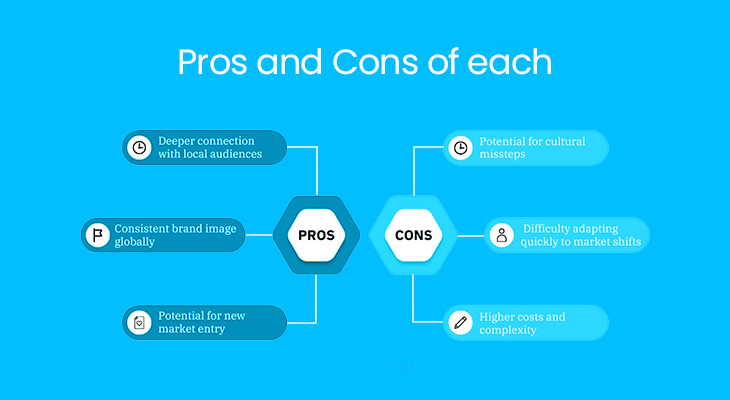
With AI-driven localization tools now capable of delivering real-time, context-aware translations at scale, there is no longer a trade off between speed and nuance. The path forward is not about choosing sides. It is about choosing flexibility, standardize where it creates stability, and localize where it creates traction. For decision-makers, the real question is no longer if localization fits into your global strategy, but how deeply you're willing to embed it into your product, content, and customer journey. Because growth does not just come from reaching more people, it comes from achieving them meaningfully.
The Bottom Line
Standardization may keep operations tidy, but customers do not buy the process. They buy the connection and communication. And that connection is forged in language, context, and cultural familiarity. Whether you're launching a digital banking platform in Ludhiana, scaling a mobile app across South Asia, or expanding your website to reach new demographics, the most innovative brands are building experiences that adapt, without compromising brand coherence.
A well-localized experience shortens the path to trust, accelerates onboarding, and positions your brand as a familiar face rather than a foreign player. The companies winning in today's fragmented markets are those treating language and culture as assets. If you're serious about growth, not just reach, but impact, then localization needs to be part of your design architecture from day one. But there is a principle that works universally, that people connect with what feels familiar. The more you adapt without diluting your brand, the more powerful and profitable your expansion becomes.