Most digital products don’t struggle in new markets because the technology is weak. They struggle because the experience feels unfamiliar.
Language is usually where this first shows up. Not loudly. Not all at once. A button label that sounds slightly off. A help article that feels translated instead of written. An app update that rolls out everywhere except the market it was meant for.
This article looks at how organizations are automating website translation and mobile app translation without changing their codebase, and why that shift matters more than it appears at first glance. The focus is practical. How translation moved from a task to a core part of digital infrastructure, and what that change unlocks for teams responsible for growth, experience, and long-term scale.
Why Language Became a Growth Constraint
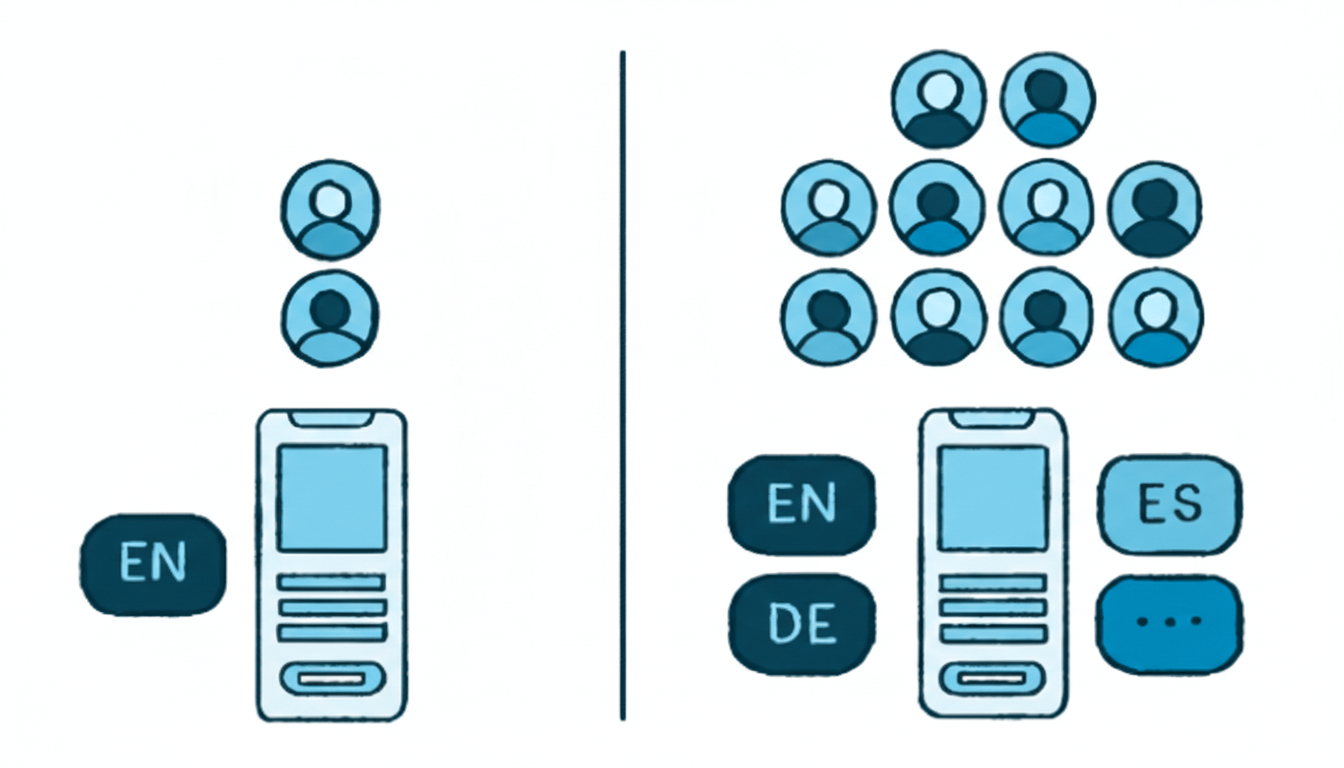
For years, English was treated as a reasonable default. That assumption no longer holds. Most new internet users today are non-English speakers. More importantly, they behave differently. They are less tolerant of friction and more sensitive to trust signals. Language is one of the most powerful of these signals.
The World Economic Forum has repeatedly stated that making language available is a key part of digital inclusion, especially in developing countries, where digital platforms are often the first way to access formal services (Source).
People often overlook the practical impact of this change. Translation is not something you do and then forget about. It is something that systems must always be able to do.
The Real Problem With Traditional Translation Workflows
On paper, most translation setups look acceptable. In practice, they start to break down as soon as content velocity increases.
The pattern is familiar. Text lives inside the codebase. Content is exported manually. Translations return days or weeks later. Even small changes require redeployment.
This works when updates are rare. It fails when products evolve weekly.
The friction is subtle. Product teams postpone copy improvements. Regional teams improvise. Engineering becomes a gatekeeper for language changes it doesn’t actually own.
McKinsey has shown how small operational bottlenecks, when repeated across digital workflows, compound into slower execution and reduced responsiveness (Source).
Translation is one of those bottlenecks, just quieter than most.
Rethinking Translation as a System, Not a Task
The most important shift here isn’t technological. It’s conceptual.
Instead of asking, “How do we translate this page?”, more mature teams start asking, “Where does language live in our architecture?”
Once that question is on the table, hard-coding language into products begins to feel outdated. It ties communication to release cycles. It assumes language changes slowly. Neither assumption reflects reality anymore.
Deloitte’s Tech Trends research consistently shows that automation creates value only when it is embedded into core systems, not added as a surface-level layer.
Language fits that pattern almost perfectly.
How No-Code Website Translation Actually Works
No-code website translation doesn’t mean engineering disappears. It means engineering is no longer required every time the language changes.
Modern approaches separate content from code at runtime. Visible text is detected dynamically, processed through translation models, and rendered in localized form without altering the underlying application.
The site stays the same. The experience shifts.
In practice, this is often delivered through translation orchestration layers such as Translation API, which sit above websites and applications rather than inside them. Their role isn’t to “do translation” in isolation, but to manage how language is detected, updated, reviewed, and governed, without putting language changes on the critical path of development.
As a result, a few things change quickly:
Content teams regain control over language.
Updates happen continuously rather than in batches.
Consistency improves across pages and regions.
At that point, translation no longer competes with development priorities.
How to do Mobile App Translation Without Release Dependency?
Mobile apps used to be even harder. Any language update meant a new build. Sometimes a new store review. Often, a delay made small fixes feel disproportionate.
That constraint no longer has to exist.
By introducing a dynamic language layer, apps can fetch and display translated content independently of the app binary after App Translation. Text changes no longer require resubmission. Users don’t need to update the app just to see clearer language.
Platforms built around dynamic language delivery, including systems like Translation API, apply this same principle to mobile environments, keeping text separate from release cycles so language can evolve without waiting on engineering schedules.
A Simple Strategic Check Using the 7S Lens
McKinsey’s 7S framework remains useful here, not as a checklist, but as a way to diagnose misalignment.
When translation automation underperforms, the issue is rarely the tool itself. More often, it’s structural.
Language strategy exists, but ownership is unclear.
Systems support automation, but processes don’t.
Teams value accessibility, but incentives reward speed elsewhere.
When those elements don’t line up, even sophisticated setups struggle to deliver impact.
What the Numbers Suggest?
Translation outcomes vary widely, but broader automation research is still instructive.
BCG has shown that AI-driven automation in repeatable content workflows can reduce turnaround times by 50–70% once manual dependencies are removed (Source).
In multilingual digital products, faster language updates tend to show up as higher engagement, not because users notice the automation, but because they stop noticing friction.
Balancing Opportunity With Caution
Automation creates leverage by removing friction. That same leverage can work against you if it runs without oversight.
When translation is automated thoughtfully, the benefits are immediate. New languages stop feeling like “projects.” Expansion into linguistically diverse markets becomes routine rather than risky. Teams spend less time on per-language cost and more time on whether the experience makes sense.
The risks emerge more slowly.
Over-reliance on raw machine output can flatten tone. Cultural nuance can fade in places where it matters most, onboarding, support, moments of uncertainty. And without clear ownership, sensitive content can drift unnoticed.
That’s why the goal isn’t full automation everywhere. It’s deliberate automation. Systems handle scale and repetition. People stay involved where judgment and context can’t be automated away.
When those boundaries are clear, automation becomes an advantage rather than a liability.
Translation Is a Living System
One reason translation initiatives stall is that they’re treated as finite projects. Translate the site. Launch the app. Move on.
Language doesn’t behave that way.
It changes as products mature, as regulations shift, and as teams learn what users actually respond to. The moment the translation is “finished,” it starts falling behind.
Automating translation without codebase dependency acknowledges this reality. Language is no longer locked to release cycles. Messaging can evolve based on real usage instead of assumptions made months earlier. Products feel current rather than frozen at launch.
This is even more visible in mobile apps. Apps are personal. They live on individual devices. Awkward phrasing or outdated instructions feel intrusive. When language updates require rebuilds, teams delay them. Small issues linger. Trust erodes.
Decoupling language from the app build removes that hesitation. Improvement becomes inexpensive. And when improvement is inexpensive, it actually happens.
Why “Good Enough” Translation Quietly Hurts Growth
Most organizations settle for translation that is technically correct but experientially weak.
The words are accurate. The meaning is intact. Yet something feels off.
Users may never articulate the problem, but they react to it. They hesitate. They abandon flows. They gravitate toward alternatives that feel clearer, even when features are similar.
This gap rarely appears cleanly in dashboards. Drops in conversion rate are often attributed to pricing, onboarding, or performance. Language absorbs the impact quietly.
Automated translation systems, when paired with review loops and governance, make it easier to close that gap. Not because machines are perfect, but because iteration becomes realistic. Language improves gradually, informed by behavior rather than guesswork.
In that sense, automation doesn’t replace human judgment. It finally gives it room to operate.
Translation as Part of Product Thinking
At a certain point, effective teams stop talking about translation altogether. They talk about clarity.
Clarity in onboarding.
Clarity in error messages.
Clarity in explaining value, risk, and next steps.
Language becomes inseparable from user experience. It’s no longer “localized content.” It’s simply the product, expressed differently.
That shift is hard to reach when translation lives inside the codebase. Every change feels expensive. Every improvement competes with feature work.
When translation is abstracted, something subtle changes. Teams experiment more. They adjust phrasing. They respond faster to confusion. Over time, the product becomes easier to use, not because it was redesigned, but because it was better understood.
That is the real promise of automating website and mobile app translation without touching the codebase. Not efficiency alone, but fluency at scale.
A Note on the Indian Context and Devnagri
Language diversity isn’t evenly distributed. Markets like India amplify every translation challenge at once: multiple scripts, cultural variation, and sheer scale.
This is where companies like Devnagri, and orchestration layers such as Translation API, tend to operate. Their value lies in handling complexity at scale while leaving room for thoughtful language decisions, rather than trying to replace them.
Closing Thought
Translation is no longer about words. It’s about intent. When people encounter a product in their own language, the message is simple: this was built with me in mind. Automation, when done well, makes that possible at scale. And today, scale isn’t optional.