There's a difference between launching globally and connecting locally. You might have the best features, slick UI, and even decent traction in your home country, but if users from other regions feel your app wasn't built for them, they won't stay long.
That's where app localization comes in. And no, it's not just about translating buttons and menus. It's about making users feel like your app belongs to them.
So, how do you get it right? Here's a clear, human-first, and business-oriented guide to doing app localization, without getting lost in technical jargon.
1. Know Who You're Localizing For, and Why
Localization isn't about picking random languages and hoping for downloads. Start with data.
Where are your current users coming from?
What markets show promising demand but low conversion?
Are there regions where cultural context could block engagement?
Example: If you're seeing app installs from Assam but low engagement, chances are your UI in English isn't hitting the right notes. Consider English to Assamese translation not just as a language change, but as a user trust move.
According to CSA Research, 76% of global users prefer content in their language, even if they're fluent in English. [source]
Localization helps users feel you built the app for them, not just translated it.

2. Design with Flexibility from the Start
Most localization problems show up when apps are designed in a "one-language-fits-all" mindset. That backfires during expansion.
Here's how you can avoid it:
Don't hardcode text inside code. Use external language files.
Support text expansion: "Logout" in English might turn into three words in another language.
Avoid embedded text in images. Changing that later is a nightmare.
Choose globally friendly fonts that support multiple scripts (like Devnagri, Cyrillic, and Arabic).
Tip: The DOTA App solves this elegantly by separating UI logic from content layers. It uses dynamic language modules, so you don't have to rebuild screens when you change languages.
Think of design as a foundation. If it's flexible, everything else becomes easier.
3. Use a Machine Translation API to Save Time
Hiring translators for every single update, feature, and change can slow you down. That's where a machine translation API earns its place.
You can plug it into your app backend and get instant translations for:
Navigation menus
Push notifications
Real-time user-generated content
Help center updates
Popular Tools like DOTA App and MT include Devnagri's Machine Translation API (for Indian and international languages). These APIs help you go live faster while cutting initial costs. They're not a replacement for human review, but a strong first step.
The global machine translation market is projected to hit $3 billion by 2027, with businesses using it for scale and speed. [source]
4. Bring in an App Translation Agency for Polished UX
Machine translation can give you a working version. But will it capture tone, humor, or cultural relevance? That's where an App translation agency helps.
Even though we're talking about mobile apps, the logic applies here too. These agencies don't just do literal translations. They:
Adapt marketing copy for local nuance.
Ensure cultural alignment (what's funny in the U.S. might fall flat in Japan).
Handle LQA (linguistic quality assurance).
Manage glossaries and term bases for brand consistency.
They're also essential if your app connects to a localized UX, blog, or support portal. A disconnect in tone or vocabulary between the app and website can create user friction.
Agencies are beneficial for high-stakes content, pricing pages, legal T&Cs, or product descriptions.
5. Localize More Than Just Text
Text is just the surface. True localization includes:
Icons and imagery: A mailbox symbol may not resonate in every country.
Colors: Red signals danger in the West but luck in China.
Audio: Voiceovers or button sounds? Users expect them in their native accent or tone.
Date, time, and currency formats: ₹1,000 ≠ $1,000
Apps like DOTA allow media and visual elements to be swapped per locale without touching the core code. This way, users in Delhi, Dubai, or Düsseldorf can see content designed just for them.
Spotify, for example, doesn't just translate, it changes playlist names, audio ads, and regional suggestions to reflect local trends.
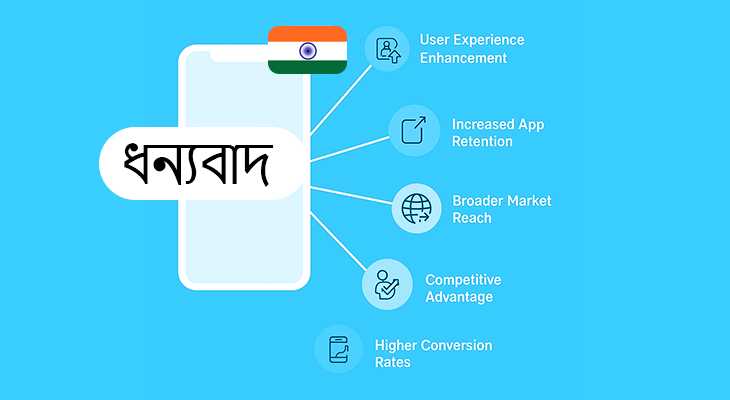
6. Build a Continuous Localization Workflow
Here's the reality: your app won't stop evolving. New features, content, and patches will keep rolling out. That means localization has to be ongoing, not one-off.
This is where continuous localization comes in.
Your steps:
Use version control tools like Git to manage language files.
Automate updates via your machine translation API.
Set triggers for LQA when content changes.
Monitor feedback from new markets and adjust.
Tools like DOTA and other modern translation platforms support localization pipelines, so you're not playing catch-up every time your dev team pushes a release.
7. Test Everything Like a Real User Would
Don't assume that because the translation is "correct," the experience will be smooth.
Your QA process should include:
Linguistic testing - Is the tone right? Are metaphors or idioms off?
Functional testing - Do longer words break buttons or layouts?
Cultural checks - Are images or phrases unintentionally offensive or irrelevant?
Regression testing - Did the latest update mess up a translated string?
DOTA's modular QA toolkit lets regional testers leave contextual feedback directly on screens, a game-changer for distributed teams.
Also, pay attention post-launch. User reviews often reveal localization problems faster than bug reports.
Bonus: Don't Forget Your Website
Your app is one half of the story. If your website, blog, or help center remains untranslated, it creates confusion.
That's why top-performing apps treat website translation as part of the localization flow. Ideally, use the same agency and translation memory across both.
Match the tone and language across platforms.
Sync your machine translation API for consistency.
Translate support docs, FAQs, and landing pages together.
A user reading your website in Hindi shouldn't be surprised when your app opens in English.
Localization is more than a Feature but a Growth Lever
If you want users from different parts of the world to feel at home inside your app, localization is your toolkit. Not just translation. Not just token efforts.

But a planned, ongoing, user-first strategy.
Here's a quick summary of your seven steps:
Study your users and pick target languages with ROI in mind.
Build flexibility into your design early and smartly.
Use a machine translation API to scale fast.
Work with a professional website translation agency for the best solution.
Go beyond words, localize media, formats, and sounds.
Build localization into your dev cycle.
Test like you live in the user's shoes.
And remember: the most powerful apps don't just work in different markets. They belong there.
Final Words
Localization isn't just about adding languages; it's about making your software feel like it was built particularly for them. People feel understood when they see, hear, and do things that are familiar to them. That's how you get people to trust you. The finest apps don't simply know how to talk to people; they also understand how they live. Instead of thinking of localization as a box to check off, think of it as a long-term relationship with your audience. Begin early, keep on track, and change as you mature. You know you're doing it correctly when your software seems local no matter where it's downloaded. That's how absolute loyalty is developed.